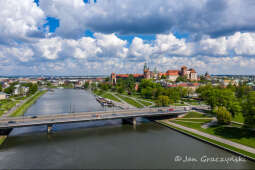







The city of Krakow, which lies on the banks of the Vistula River, was for centuries the capital of Poland, and has accumulated a quarter of Poland’s total number of museum artefacts.
A visit to Krakow is a meeting with the most glorious era in Polish history. Krakow’s Old Town, along with Wawel Castle and the city’s Kazimierz district were placed on the First World Heritage List, created by UNESCO in 1978. At that time, such prestigious recognition had been awarded to only 12 of the world’s most famous heritage sites, including the Egyptian pyramids and the Great Wall of China. Today, the list contains more than 900 sites worldwide.
THE MAIN MARKET SQUARE
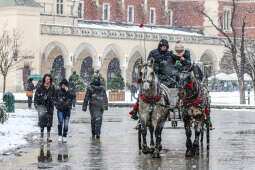
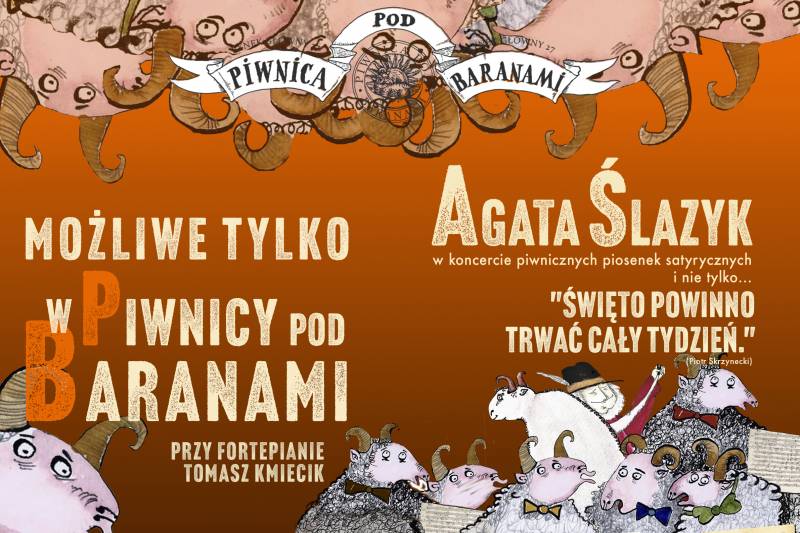
It is the largest medieval square in Europe. Measuring approximately 200 metres by 200 metres, it was laid out when the city received its charter in 1257. Unlike the Cloth Hall, he Town Hall and the town houses that border the square, the churches of St Maryand St Adalbert were built before the charter and so are not aligned with the sides of the Main Market Square. The vital addition to the square is the monument of Adam Mickiewicz, designed in 1898 by Teodor Rygier. Looking at the restored colourful townhouses and mansions surrounding the square it is hard to believe that they are 500-600 years old. The Grey House (Szara Kamienica) at no. 6 deserves a closer look. Legend has it that it was donated by King Casimir the Great to his mistress, Sarah. The Pod Krzysztofory Palace at no. 35 is noteworthy as kings John Casimir, Michał Korybut Wisniowiecki and Duke Józef Poniatowski all stayed there at one time or other, and from it there is a wonderful panorama of the Main Market Square with St Mary’s Church, the Town Hall Tower, Adam Mickiewicz’s monument and the Cloth Hall. The Pod Baranami Palace (Rams’ Palace) at no. 27 is the home of a popular cabaret. House No. 15 is renowned for its restaurant, Wierzynek, whose traditions go back to a famous feast held at the house in 1364. In September 2010 under the Main Market Square, the biggest European underground museum, with around 4,000m², containing a modern multimedia exhibition entitled ‘Following the traces of Krakow’s European identity’ and a tourist route situated 4metres below ground, was finally opened.
1. THE CLOTH HALL
The origins of the Cloth Hall go back to the 13th century, but at that time it was just two rows of stalls selling textiles. In the times of Casimir the Great, a108-metre long gothic hall was built, which was destroyed during a. re in 1555. The Cloth Hall was reconstructed as an impressive building (the stairs and loggia were designed by J. M. Padovano), crowned with a Renaissance attic adorned with mascarons. The Cloth Hall took on its final shape in the 19th century when it was rebuilt in accordance with T.Prylinski’s design. It was then that the familiar neo-Gothic arcades were added. Continuing acenturies-old tradition, trade still flourishes in the stylish stalls of the Cloth Hall. Merchant and guild emblems may be seen on the walls, along with the armorial bearings of Polish cities. The upper floor houses the Gallery of 19th Century Polish Art in the Sukiennice, where one can admire famous works by P. Michałowski, H. Siemiradzki (Nero’s Torches), J. Matejko (The Prussian Homage), (Kosciuszko in The Battle of Racławice) and W. Podkowinski (The Frezny), as well as canvasses by A. Grottger, A. Gierymski, J. Chełmonski and J. Malczewski.
2. ST MARY’S CHURCH
The church, founded by Krakow’s burghers in the13thc., is one of the. nest Gothic parish churches in Poland. Its interior captivates the viewer with its outstanding polychromes by Jan Matejko, as well as by its stained-glass windows (from the14thc.) and those designed by S. Wyspianski and J .Mehoffer. One should take a glance at the epitaphs of prominent families and take a seat in the wooden Baroque stalls, reserved centuries ago for Krakow city councillors and magnates. But the real jewel of the basilica is its high-altar, which took the master craftsman Wit Stwosz (Veit Stoss) 12years to complete.
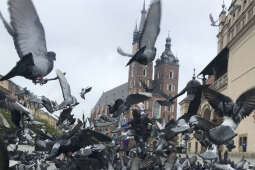
It is 13metres high and11 metres wide and is the largest medieval wooden altar in Europe. The altar consists of 200 figures, from several centimeters to 3metres high, carved with great precision revealing all anatomical details. The central scene depicts the Dormition of Our Lady; bas-reliefs on the side-wings illustrate scenes from the New Testament. From the higher of the two towers of the church (81m), a bugle is played every hour. Behind the basilica is the smaller Mariacki Square (on the site of a former parish graveyard that was in use until the19thc.), and the charming St Barbara’s Church which dates from the14th c. (and was once a funeral chapel). In the evenings, the Main Market Square has an atmosphere all of its own.
3. ST ADALBERT’S CHURCH
This Romanesque church is one of the oldest historical buildings in Krakow. It dates back to the10th c., although what you see today was reconstructed in the17th c. Legend has it that the church was built on the site St. Adalbert gave sermons from. In 1241, Cracovians found shelter there during the Mongol invasion led by Batu-Khan’s army. Several steps down lead us to the interior of the church, as the ground level is now higher than during the Middle Ages. Once inside, one should not miss the. Figure of Christ on the cross on the roodscreen. The crypt houses an exhibition on the history of Krakow’s Main Market Square, where one can see wooden water pipes dating from the15th-16th centuries.
4. THE TOWN HALL TOWER
The brick tower is the only surviving part of Krakow’s Town Hall which was built in the14thc. Badly dilapidated, the Town Hall was demolished in the early 19th c. The tower is 70 metres high. The entrance on the side of the Cloth Hall is guarded by two stone lions. The Tower houses a section of the Historical Museum; the vaults offer avenue for the Ludowy Theatre (The Town Hall Stage). It is worth making thee. ort to climb the tower to admire the impressive panorama of the Old Town. On the Square, between the Town Hall Tower and Szewska Street one can see a commemorative plaque at the site where Tadeusz Kosciuszko took the oath as the leader of the nation in 1794.
AROUND THE MAIN MARKET SQUARE
The historic architecture and medieval urban layout have survived in the area surrounding the Main Market Square .Many architectural landmarks that recall the medieval past now house smart shops, elegant restaurants and cafes, which make sightseeing in the old town a real pleasure.
5. THE BARBICAN
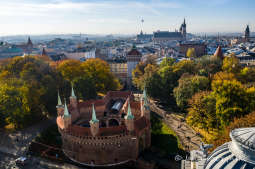
This 15th-century defensive bastion, located several dozen metres outside the city walls, was originally surrounded with a moat and was connected to the Florianska Gate by a passageway. It was built to defend the first wave of an enemy attack. The Barbican has seven turrets and 130 embrasures. Its walls are more than 3 metres thick. It is the largest such structure in Poland and one of the best preserved in Europe.
6. THE FLORIANSKA GATE
Built at the turn of the13th/14th centuries with neighbouring walls and three towers, the gate was part of the powerful three-kilometre fortification system which once surrounded Krakow. It was reinforced with 47 towers, eight gates and a moat. Florianska Gate marked the beginning of the Royal Route, which royal and envoy processions took on their way to Wawel Castle. In the19th c., the city walls were demolished and replaced by Planty Park.
7. THE SŁOWACKI THEATRE
This eclectic building, modelled after the Paris Opera House, was designed by Jan Zawiejski and built in 1893. Poland’s most distinguished actors – Helena Modrzejewska, Aleksander Zelwerowicz and Ludwik Solski (the theatre director 1905-1913) – performed on its stage. It was the venue for world premieres of Kordian (1899), Forefathers’ Night and. The Wedding (1901). The stage is adorned with a. ne curtain by Henryk Siemiradzki, who painted on it various allegorical and symbolic figures connected with theatrical art. The famous dressing room once used by Solski may also be visited at the theatre.
8. THE CHURCH OF THE HOLY CROSS
This is one of the most beautiful examples of Gothic architecture in Poland. Especially noteworthy is its original palm vaulting, supported by just one pillar. The walls of the chancel and of the aisle are covered with interesting 15th and16thc. paintings, renovated by Stanisław Wyspianski.
9. THE PIARIST CHURCH
This 18th-century church has a rich Baroque interior, including the most impressive illusion painting on the vaulting in the main aisle and. Ne paintings and stuccoes in the side chapels. The high-altar contains a copy of Rafael’s Lord’s Trans¡ guration. Right of the altar is the urn with the heart of the Piarist, Stanisław Konarski. Adjoining the church is the Municipal Arsenal which houses part of the Princes Czartoryski Museum collection.
10. THE PRINCES CZARTORYSKI MUSEUM
Opposite the Piarists’ church is the Princes Czartoryski Museum. The exhibition includes masterpieces of world painting, including Leonardo da Vinci’s Lady with an Ermine and Rembrandt’s . The Landscape with Good Samaritan, as well as works by Italian, German and Flemish masters. The collection is enriched with souvenirs left by Polish kings, hetmans and generals and a wonderful china collection. The museum was established in 1800in Pulawy on the initiative of Duchess Izabella Czartoryska. In January 2010 thorough modernisation of the Princes Czartoryski Museum was launched, which is planned to be completed by autumn 2012.
11. ST ANNE’S CHURCH
The largest Baroque church in Krakow, dating from the turn of the17th/18th centuries was founded by professors of the Jagiellonian University and designed by the Dutch architect Tilman van Gameren. He designed the church in such away that the entire facade can be viewed from an arrow street. The collegiate church was the place of worship of St John Cantius – in the side altar is a sarcophagus with the relics of the saint. The fine stucco decoration by the Italian Baldassare Fontana, is especially noteworthy.
12. THE COLLEGIUM MAIUS
The inscription Plus ratio quam vis (Reason over force) lies on the wall of the Jagiellonian Ceremonial Roomof Collegium Maius. The oldest seat of Krakow University was founded by the Jagiellons in 1400, but over the centuries was remodelled several times. A small, quiet courtyard surrounded with 15th-century arcades, is one of Krakow’s most magical sites. Its arcaded passages, the Jagiellonian University Museum with its interesting library collection, the oldest Rector’s insignia, astronomical instruments and a unique collection of ancient globes, are certainly worth a visit.
13. THE DOMINICAN CHURCH AND MONASTERY
The original rich interior furnishings of this Gothic church were destroyed during a. re in themid-19thc. The current interior decor is in the neo-Gothic style. Interesting elements of the church include the Chapel of the Rosary (17thc.),the Chapel of St Hyacinth, the co-founder and the first prior of the monastery (14th c.), and Veit Stoss’s sepulchral plate (on the left from the high altar) of the outstanding humanist Filip Buonaccorsi (Kallimach). The passages of the Dominican Monastery adjoining the church are also open to visitors.
14. THE FRANCISCAN CHURCH AND MONASTERY
This Gothic church was founded by Boleslaus the Chaste in themid-13thc. The Duke found his place of final rest here, along with his sister, Blessed Salomea. The church is particularly interesting because of Stanisław Wyspianski’s stained-glass windows in the chancel depicting St Francis, Blessed Salomea and the four elements, a. ne colourful polychrome in the chancel and the transept and, the real masterpiece – God the Father – a stained-glass window over the main entrance. The stations of the Via Dolorosa were painted by Józef Mehoffer.
15. THE CHURCH OF SS. PETER AND PAUL
The church, built at the turn of the16th/17th centuries, was erected on the initiative of the Rev. Piotr Skarga and funded by Sigismund III Vasa for the Jesuits. It was designed by great architects, including Giovanni Trevano, and was modelled after the Roman church, the Il Gesù. In the crypt under the chancel Piotr Skarga is buried in a silver coffin. The church has a. ne cupola on which a Foucault pendulum was hung. Its swinging proves the rotary movement of the Earth. The church is guarded by the twelve apostles, which are copies of the original 17th-century sculptures.
16. ST ANDREW’S CHURCH
The Romanesque church dates from the12th c. and is one of the oldest buildings in Poland. Its thick walls (1.5 m) and narrow windows prove that it also had a defensive function. Its small interior is stunning with its splendid Baroque decor; its rococo boat-shaped pulpit is especially noteworthy. The treasury of the convent of Sisters of St Clara adjoining the church houses precious reliquaries from the13thc., a unique mosaic with Our Lady dating from the turn of the12th/13th centuries and a set of Nativity figurines from the14thc., among the oldest in Europe.
WAWEL
Wawel Hill was the centre of the Wislanie state before the state of Poland was established. The Piast dynasty settled here in the late 10th_c. The first king to have his coronation at Wawel was Ladislaus the Elbow-High in 1320. According to archaeologists, in the Middle Ages there were as many as seven Gothic churches on the hill and numerous other buildings, which were later destroyed. The Rotunda of Ss Felix and Adauctus and the Romanesque elements of the cathedral vaults are believed to be the oldest landmark on the hill (ca. 950). Elements of old structures are displayed at the exhibition ‘The Lost Wawel’, along with a computer presentation.
17. THE ROYAL CASTLE
Wawel Castle, which was redesigned several times throughout the centuries, is a combination of the Gothic and the Renaissance styles. The royal residence was designed by such masters as Francesco of Florence and Bartolomeo Berrecci. When Berrecci had completed his work, he placed the following inscription over the entrance gate Si Deus nobiscum quis contra nos (If God is with us, who will be against us?) Four exhibitions are open to visitors – The Royal Chambers, the Royal Apartments, The Treasury and the Armoury, and the Orient in Wawel collections. One can also visit the towers. One of the. nest rooms in the castle is the Room of the Envoys, also known as “Under the Heads”, as its coffered ceiling contains sculpted heads (16thc.). The largest is the Senators’ Room (240 square meters) in which Senate meetings, court ceremonies and balls were held. It is also worth visiting the Royal Treasury (with the royal coronation sword Szczerbiec) and the Armoury which contains a rich collection of weapons. The jewels of Wawel are its Arras tapestries woven from wool, silk and metallic thread in Brussels workshops. They were commissioned by King Sigismund II Augustus (1520-1572). Some 136 tapestries out of 360 have survived in this collection, which is ranked among the largest in Europe.
18. CATHEDRAL
This building represents an array of epochs and styles. The Gothic structure is surrounded by twenty-one Gothic, Renaissance, and Baroque chapels. Inside its majestic, dark interior are the royal sarcophagi, the silver confession of St Stanislaus, early- Renaissance stalls and the beautiful black crucifix of Queen Jadwiga. Thirty-seven royal coronations took place in this cathedral. Almost all of Poland’s kings found their final resting place here – from Ladislaus the Elbow- High to Augustus II the Strong (1670-1733). Eminent Polishmen such as Tadeusz Kosciuszko, Józef Piłsudski, Władysław Sikorski, Adam Mickiewicz and Juliusz Słowacki were also buried in the cathedral crypts. Among the chapels, the most beautiful is the Zygmuntowska (Sigismund’s) Chapel, areal Renaissance masterpiece. It is also worth taking thee. ort to climb Sigismund Tower to see the huge, famous bell known as ‘Sigismund’, cast in the16thc. From cannons weighing 12.7 tonnes. Twelve people are needed to ring it. Its sound is heard from as far as 12 km away. In 2000, its clapper broke. The new clapper, weighing 350 kg, was cast and hung after a few months.
KAZIMIERZ
Kazimierz was established by King Casimir (Kazimierz) the Great as a separate town. In the late 15th_c., an autonomous Jewish district was established here. Depopulated And dilapidated after the Second World War, the district is currently recovering its original splendour. It is the second largest complex of historic Jewish architecture after Josefov in Prague. Its historic centre is Wolnica Square but its social and cultural life focuses around the Plac Nowy square and Szeroka street.
19. THE OLD SYNAGOGUE
Situated in Szeroka Street, the former commercial centre of Kazimierz, the synagogue was built in the15thc. By Czech Jews and is the oldest synagogue in Poland. During the Second World War it was plundered and devastated by the Nazis. After the war, the synagogue was renovated to serve as a Jewish history museum. One may see there are constructed bimah, a Baroque collection box, a Torah Ark, various ritual artefacts and everyday utensils. A separate room is devoted to the Holocaust of Krakow Jews.
20. REMUH SYNAGOGUE AND CEMETERY
Built in the16thc., it is the smallest of the synagogues in Kazimierz and is still used for religious worship. It may be visited outside service hours. Next to it lies the beautiful Renaissance cemetery with numerous historic tombstones. The matzevahs and sarcophagi are adorned with intriguing ornamental motifs and are being renovated one after another. The most venerated site is the tomb of Rabbi Moses Isserless (Remuh) which draws Jewish pilgrims from all over the world.
21. ISAAC’S SYNAGOGUE
A large Baroque synagogue was built in themid-17thc. It was commissioned by Izaak Jakubowicz, a rich merchant and banker. Its arcaded portal and fine stucco-work adorn the building and there also some interesting 17th-century inscriptions on the walls. Destroyed by the Nazis during the Second World War, it has been gradually renovated since the1980s. Inside, visitors may watch two films about Jewish martyrdom.
22. TEMPEL SYNAGOGUE
The newest of the synagogues in Kazimierz, this was built in the second half of the19thc. by the Association of Progressive Israelites. Services were delivered here in Polish and German; changes were introduced to the liturgy, which raised protests among Orthodox Jews. The interior of the synagogue has been renovated by the World Monuments Fund. The women’s gallery and the ceiling are richly adorned with stuccoes and frescoes in an Oriental-Moorish style. The fine 19th-century stained glass windows on the ground floor and the upper floor add to the charms of the synagogue interior.
23. CORPUS CHRISTI CHURCH
One of Krakow’s greatest churches, it was founded by Casimir the Great and blends various architectural styles together – late Gothic (top of the facade), Renaissance (belfry), and Baroque (side chapels). In its atmospheric interior one can admire masterpieces of sculpture –the17th-century stalls in the chancel andthe18th-century pulpit. The high altar contains the famous Nativity attributed to Tomasso Dolabella (17thc.). The left aisle contains an altar-mausoleum (famous for its miracle-making power) with the remains of the St Stanisław Kazimierczyk, a Regular Lateran canon.
24. ST CATHERINE’S CHURCH
This Augustinian church, also founded by Casimir the Great, represents Krakow’s Gothic style at its best. The great structure of the church looks particularly impressive since its recent renovation. The church’s bright interior reveal the beauty of the high-altar, carved by thecity’s craftsmen in the17thc., the ornamental stalls anda15th-century figure of Madonna with Child and wall paintings in the chancel with scenes from the life of St Augustine. Medieval paintings can also be seen in the adjoining ambulatories of the Augustinian Monastery.
25. THE PAULINE CHURCH ON SKAŁKA
The origins of the church date back to the10thc. It is traditionally believed to have been the site where St Stanislaus was murderd by Boleslaus the Bold. In the left aisle is an altar with a scene of the death of the saint. The interior of the church is a real jewel of the Baroque style – pastel colours, gilt ornaments, sculptures of angels and saints. The rococo organ is an especially valuable element of interior furnishing. In the Crypt of the Meritorious below the church lie the remains of great 19thand20thc. Polish figures such as Jan Dlugosz, Jozef Ignacy Kraszewski, Karol Szymanowski, Adam Asnyk, Stanisław Wyspianski, Jacek Malczewski, Henryk Siemiradzki and Czesław Milosz. In front of the church is a pond with the statue of St Stanislaus – legend has it that the quartered body of the martyr was thrown into the pond. An important tourist route, the Route of Krakow Technology runs through Kazimierz and the area of Podgórze – on St. Wawrzyńca street in the former halls of the Tram Depot where the Museum of Urban Engineering is housed today. At Lipowa Street 4, in the historic buildings of the Oskar Schindler’s Factory, a branch of the Historical Museum of the City of Krakow – the Schindler’s Emalia Factory Museum, where you can visit a permanent exhibition entitled “Krakow Under Nazi Occupation (1939-1945)” was also opened. It also houses the newly established Museum of Contemporary Art.