






wersja dla przeglądarki głosowej


Practical information
Arrival
City Centre Map
Tourist Information Network
Hotels
Recommended Restaurants
Polish Language Courses
Money, shopping
Dear turist! You are not helpless!
Important telephone numbers
Post offices, Fax, Internet
City guides
Trips around Krakow and vicinity
Krakow Tourist Card
Transport
Krakow's Main Attractions
The Royal Castle on Wawel Hill
The Main Square
St Mary's Church
The City Centre
Kazimierz District
Vistula River Trips
Nowa Huta District
From a Slightly Different Angle
Aqua Park in Krakow
Krakow Valley Golf & Country Club
Royal Kraków Golf & Country Club
Outside the city
Gourmet Tourism
Tourist routes and guides
The Royal Route
The University Route
In the Footsteps of John Paul II
Jewish Heritage Route
Saint Stanislaus of Krakow Route
Podgórze Historical Route
Nowa Huta Route
The Krakow Iindustrial Heritage Route
Other
Publications to download
Krakow ABC

Tourism

Kościół Mariacki

The Centre

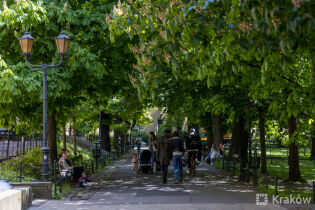
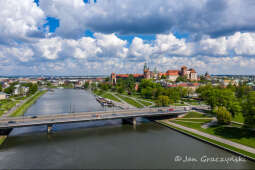
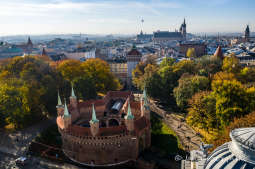
Let us, however, return to the spatial layout of the city, as it has been, to a great extent, decisive for the atmosphere of Krakow. The area enclosed by the Planty is traditionally considered the very centre of Krakow. The Planty is narrow ring of greenery extending from The Barbican and embracing the city centre in an irregular, oval-like shape, elongated towards the Vistula, and reaching the foot of Wawel Hill. The Planty was designed as a garden ring in the 19th century to replace the demolished city walls that had used to contain the most ancient part of Krakow - the city itself. The area whose width never exceeds 1,500 metres, and length - 800 metres, and where nearly every house is of historical value, houses several dozen museums and galleries, a number of churches, theatres, cinemas, bookshops and antique shops, shopping malls and whole streets lined with shops, as well as hundreds of cafés, restaurants and pubs. This description serves to bring a small town to mind. Little wonder that most tourists are astounded to learn that the number of residents in the Krakow metropolitan area actually verges on 800,000.

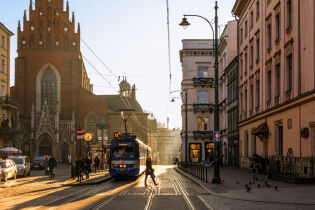
With so much of city's life concentrated in the centre, a visit becoming that much easier to plan. The longest straight line that can be drawn within The Planty Ring runs nearly exactly along the Royal Route - the oldest and, in all likelihood, also the best-known tourist route. The Royal Route leads from the Barbican and St Florian's Gate, situated in the only major well-preserved section of the powerful city defence walls (also housing the Arsenal: today, a section of the Czartoryski Princes Museum), down ul. Floriańska to the Main Market Square. From here, it takes the visitor along ul. Grodzka and ul. Kanonicza to Wawel Royal Castle. The route, closely related to the period of the greatest magnificence of the Royal Capital City of Krakow, is both historic and legendary.

In 1997, thanks to the concept of Andrzej Wajda, the Parade of Kings to Wawel was held along the Royal Route. The inspiration for this monumental open-air show was the modernist design of a sculpture by Wacław Szymanowski.

On our way, we pass several museums, which include the House of Jan Matejko, and the Museum of Archaeology, as well as a number of galleries, one of which is tiny, yet significant in the world of art, the Jan Fejkiel Gallery, specialising in prints. The churches en route definitely deserve special attention: in Wszystkich Świętych Square there is the Franciscan Church featuring famous stained-glass windows by Stanisław Wyspiański, the Dominican Church and, further down ul. Grodzka: SS. Peter and Paul's Church and St Andrew's Church, both believed to be pearls of their respective architectural styles.

 Multimedia...
Map
Webcams
Panorama
Wallpapers
Photos to download
E-postcards
Photogallery
    Guest book Page Map Start with MK Editor search Back up    
Copyrights by (1996 - 2010) ACK CYFRONET AGH.
Projekt graficznyFORMS Group