







wersja dla przeglądarki głosowej


KRAKOW THE CITY OF ARTISTS
Introduction
ARTISTS
Allan Rzepka
Bogusław Schaeffer
Bronisław Chromy
Eugeniusz Mucha
Grzegorz Sztwiertnia
Ignacy Czwartos
Jacek Malczewski
Jacek Sroka
Jan Pamuła
Jan Stanisławski
Janek Simon
JANINA KRAUPE-ŚWIDERSKA
Janusz Trzebiatowski
Jerzy Bereś
Jerzy Nowosielski
Jerzy Panek
Jerzy Skarżyński
Julian Fałat
Joanna Kaiser
Józef Szajna
Lidka Krawczyk i Wojtek Krawczyk
Leon Wyczółkowski
LESZEK DUTKA
Łukasz Skąpski
Małgorzata Bundzewicz
Marcin Maciejowski
Maria Jarema
Robert Sowa
Stanisław Tabisz (born 1956)
Stanisław Wyspiański
Tadeusz Kantor
Teodor Axentowicz
Teresa Kotkowska-Rzepecka
Wacław Taranczewski
Wilhelm Sasnal
Wojciech Weiss

Culture


Stanisław Wyspiański(January 15, 1869 Krakow - November 28, 1907 Krakow)


"I can see my giant theatre,
its great air spaces,
full of people and shadows,
I can feel their acting."
S. Wyspiański, And I can still see their faces, 1904


One of the most multifaceted Polish artists: a poet, playwright, painter, graphic artist, architect, interior designer, expert on ancient Greece and medieval Poland, interested in astronomy, he was a precursor of modern typography and interior decoration and a great theatre reformer. His interests were so broad that many people called him the Polish "Leonardo Da Vinci".

Stanisław Wyspiański was born to the sculptor Franciszek Wyspiański and Maria Rogowska in the house at 14 Krupnicza Street (now 26 Krupnicza Street). From 1873, Wyspiański lived in the house of Jan Długosz at 25 Kanoniczna Street, at the bottom of the Wawel Hill, occupied by the Austrians at that time, where his father's atelier was situated. The Wawel Hill, whose history Wyspiański knew perfectly, became the source of his artistic inspirations both in paintings and dramas.

Wyspiański's mother died when he was 7 years old. His father could not fulfil his parental responsibilities and from 1880 Wyspiański was brought up by his childless uncle Kazimierz Stankiewicz and aunt Joanna Stankiewiczowa (née Rogowska), who treated him as their own child. At that time, they lived in the tenement at 1 Kopernika Street (where today the "Wyspiański" hotel is situated).

Wyspiański received a perfect education. At the age of twenty he could fluently speak Greek and Latin and was good at German and French. Through studies at the Jagiellonian University he received a grounding in history, including the history of literature and art, and became fully convinced of the ancient origins of European art. He obtained a professional painting education at the Krakow Academy of Fine Arts, under the supervision of Jan Matejko. Later, he supplemented his knowledge abroad, e.g. at the Académie Colarossi in Paris. During his school years he began friendships, cherished for the rest of his life, with Józef Mehoffer (a painter), Henryk Opieński (a composer), Stanisław Estreicher (a scientist and professor of the Jagiellonian University), Lucjan Rydel (a poet and playwright), Adam Chmiel (a historian of cultures, enthusiast of and expert on Krakow) and Kaziemierz Tetmajer (a poet).

Between 1890 and 1894, encouraged by the architect and French art lover Tadeusz Stryjeński, Wyspiański went several times to Paris. There, he got to know some of the world's great paintings, French classic painters, but also the latest artistic trends of the time - impressionism, naturalism, symbolism. He became acquainted with Paul Gauguin. On his last journey to Paris, Wyspiański stayed at his atelier, although the artists did not agree with each other about the harmony of colours.

Fascinated with the beauty of Gothic cathedrals in France, he wrote to Lucjan Rydel: "This is not a single, harmonious, melodious and charming instrument, but a huge orchestral instrumentation with deep trumpet tones, a rhythmical drum time, chorus of melodious recorders and ring of gold-string harps" . He frequently attended Paris theatres. Wyspiański's first attempts at drama (the sketches Legend [Legenda] and Varsovian Anthem [Warszawianka]) were created there. Fascinated with the atmosphere of Paris, he wanted to study at the Ecole des Beaux Arts. However, when he was not admitted, he began - together with Józef Mehoffer - studies at the private Académie Colarossi in Paris.

One of the first crucial paintings by Stanisław Wyspiański, created when he was still a student of the Krakow Academy of Fine Arts, was a polychrome in St. Mary's Church, designed by Jan Matejko. In 1889, Matejko invited Stanisław Wyspiański (his favourite student) and Józef Mehoffer to work, as assistants, on a polychrome in St. Mary's Church, which was being renovated at that time. Another common work by Stanisław Wyspiański and Józef Mehoffer was the creation of 36 stained glass windows for St. Mary's Church, depicting scenes from the Bible.

Wyspiański's most outstanding works include stained glass windows for the Franciscan Church: the cycle of personification of the four elements, air, water, fire and earth, the breathtaking stained glass window God the Father - Become! (Bóg Ojciec - Stań się), stained glass windows with the figure of St. Francis of Assisi, the church's patron and the founder of the Order and St. Salomea, the first Polish Poor Clare (Blessed Salomea [Błogosławiona Salomea]) as well as a polychrome in the chancel of this temple.

Today, Wyspiański's works may also be seen at the Medical Society House on Radziwiłłowska Street. For the first time, the artist could bring to life a whole project of interior design there, including the colours of each room as well as stained glass windows, furniture and decorative ornaments. Especially interesting are the staircase with famous brass banister using the chestnut motif as well as stained glass windows with the central pane showing Apollo the God of the Sun.

A lot of Wyspiański's projects were not implemented. One of them is the project of Wyspiański's high hopes - stained glass windows in the Lvov Cathedral "Vows of John II Casimir" (Śluby Jana Kazimierza) with the famous figure of Polonia or Madonna and Child (Madonna z Dzieciątkiem). An eight-metre-high design is now included in the collection of the National Museum in Krakow. The stained glass windows of Wyspiański's design St. Stanislaus of Szczepanów, Henry II the Pious and Casimir III the Great, designed for the Wawel Cathedral, only saw light of day in the windows of the Pavilion Wyspiański 2000, founded by the City of Krakow and opened to the public in 2007.

Among the artist's unrealized projects there is also a curtain for the City Theatre in Krakow, designed by Wyspiański for the contest in 1892. After a stormy discussion, the jury chose the design by Henryk Siemiradzki, who was not a contest participant.

Wyspiański was a great landscape painter. Worth mentioning is a well-known cycle of a dozen landscapes, Views over the Mound (Widoki na Kopiec). He was also a master of portraits, although he never painted to order. His gallery of portraits includes friends and artists, writers, actors, journalists and family members. He painted people he was emotionally related to. The most personal are the portraits of his wife and children - Helenka, Mietek and Staś Wyspiański. The artist's wife, Teofila Pytko is the central figure of many of his paintings. Teofila posed not only for paintings depicting motherhood, but also for other paintings, for example Fallen Angels (Upadłe anioły). The well-known figure of Polonia from the stained glass window for the Lvov Cathedral had Teofila's face. The pastel technique was Wyspiański's favourite painting technique.

Wyspiański was additionally a respected book illustrator. He worked together with Stanisław Przybyszewski, the editor of Życie. Tygodnik Ilustrowany Literacki i Artystyczny. In 1898 Wyspiański was appointed as an art director of the magazine. He changed the editorial layout of the magazine, making its format and the typographical arrangement (e.g. typeface) smaller. In July 1903, a bilingual version of the Iliad, designed and illustrated by Wyspiański, was published.

Thirty-one of Wyspiański's works from this domain, including issues of Życie (Life) magazine and book designs - editions of his own and other authors' dramas - were shown at the exhibition organized by the Polish Applied Art Society at the turn of 1904/1905 in the Czapski Palace. After the exhibition, Wyspiański was awarded with the order of merit for the Polish printing industry.

Stanisław Wyspiański was one of the founders of the Society of Polish Artists "Sztuka" ("Art"), which became the centre of the artistic environment of that time (1897). In 1905, Wyspiański applied for the position of director of the City Theatre in Krakow. Although he was a highly regarded artist, the city authorities did not decide to entrust him with this position. A famous actor and director of the time, Ludwik Solski, was appointed director of the City Theatre. This decision, though unfavourable to Wyspiański, did not have a negative influence on the artists' friendship. Ludwik Solski put many of Wyspiański's dramas on the stage of the City Theatre.

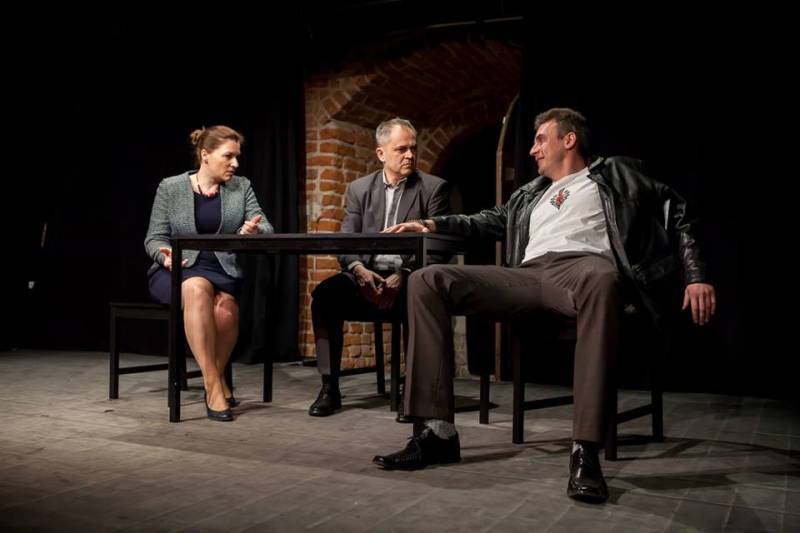
Stanisław Wyspiański introduced a new type of theatre performance, namely staging theatre, later also called enormous theatre, monumental theatre or total theatre. In the 1920s this kind of theatre, originating directly from the output of Richard Wagner - staging theatre - became the most characteristic poetics of the theatre reform. Performances of staging theatre were always the author's performances, which constituted the personal expression of a given artist, being a performance director at the same time. Staging theatre producers used many conventions, combining elements of different art domains, different periods of theatre history and different artistic techniques and technologies of moving stage sets. A groundbreaking masterpiece of the theatre reform was the staging of The Wedding (Wesele).

The drama showed a bitter picture of the helplessness of a society which was triply fettered: by the political regime, the inert national tradition and the mistrustful scepticism of the intelligentsia. It was the first performance in the Polish theatre in which, on such a scale, sets defined the scenery, all plastic items played an important role, and the light built mood and dramatic tension. Wyspiański also prepared the musical setting, which played an important dramatic role. The finale - a scene composed without words, solely with movement and melody - was totally innovative.

Wyspiański did not only begin the reform, but also - as Kazimierz Braun wrote - took it to the level of a synthesis which "anticipated the solutions applied elsewhere so much that many years had to pass for the type of theatre created by Wyspiański to spread all over Europe" .

Wyspiański, as a reformer of the theatre and the first Polish staging theatre producer, appeared in the European consciousness due to the publication by Leon Schiller "The New Theatre in Poland: Stanisław Wyspiański" in volume II of the 1909/1910 issue of "The Mask" magazine, edited in Florence by Gordon Craig .

As Kazimierz Braun wrote: "Wyspiański's attitude towards theatre was paradoxical. He demystified it and sacralized it at the same time. He rejected and destroyed it, but simultaneously he made it the heart of "Polish thought" (Myśl Polska) and the universe. For the first time in the history of European theatre he unveiled the theatre, showed an empty and naked stage in the prologue to "Liberation" ("Wyzwolenie"). Participating in the stage adaptation of this drama, he advised performing act II against the background of the painted valves used in act I, but turned around. Thus, he showed the backstage, the inside of the theatre. But in the same work he called the theatre "the temple of art" .

Wyspiański made his debut as a playwright on the stage of the City Theatre in Krakow where in November 1898 his Varsovian Anthem (Warszawianka) was performed. Soon after that, his poem-rhapsodies were created: Boleslaus the Bold (Bolesław Śmiały), St. Stanislaus (Św. Stanisław), Henry II the Pious at Legnica (Henryk Pobożny pod Legnicą), Piast, Casimir III the Great (Kazimierz Wielki). At the same time, Wyspiański created the designs of stained glass windows on the same subject for the Wawel Cathedral. The great event and Wyspiański's success was the premiere of The Wedding on 16 March 1901, a drama based on the authentic wedding reception of Wyspiański's friend Lucjan Rydel and Helena Mikołajczykówna in Bronowice. The performance starred the finest actors of that time, who played exquisitely. As soon as the play was published in 1901, it became the subject of numerous analyses and discussions.

Following the great success of The Wedding, Wyspiański was entrusted with the staging of Forefathers' Eve (Dziady) by Adam Mickiewicz. Wyspiański joined all parts of Mickiewicz's masterpiece into a whole, emphasizing the tragedy of the main character and reducing the messianic themes. The premiere took place on 31 October 1901 and was not only the first theatre production of the work, but also the first instance of creative staging of a Romantic drama in the history of the Polish theatre . "Wyspiański's stage adaptation, adopted in the following years by other theatres, survived as the only one in almost unchanged form for thirty years" until the Lvov premiere of Forefathers' Eve directed by Leon Schiller (18 March 1932).

Wyspiański wrote: "Drama has always been my dream. Leading every thought, every concept, every composition to a drama (…) has always been in my heart and I am not angry with those who called me an actor, because if it is possible to love like this, I was in love with the stage". Although Wyspiański introduced many changes into Polish stage art, he did not create a homogeneous, concise theory of the theatre. He was also the author of several works concerning drama, e.g. A study of Hamlet (Studium o "Hamlecie") by Shakespeare and a study of the aforementioned Forefathers' Eve by Mickiewicz.

Among Wyspiański's most important dramas the following should be enumerated as well: Liberation (Wyzwolenie), Acropolis (Akrolpolis), Legend II (Legenda II), November Night (Noc listopadowa), and, published in 1907, Skałka, Return of Odysseus (Powrót Odysa) and Judges (Sędziowie). Many of those dramas were staged already in Wyspiański's lifetime, often with his active participation.

The most creative period in Wyspiański's life was the time of stability living in his apartment at 79 Krowoderska Street, where in 1901 the Wyspiańskis rented the whole wing on the upper, second floor. During this time, Wyspiański created his best dramas, his most famous stage adaptations and interior designs. He made the famous "sapphire studio" there, with all the walls and the ceiling painted blue, while other rooms were painted equally vividly, for example a children's bedroom next to the atelier was painted yellow. The walls were decorated with the artist's works, e.g. with the image of a goat which was brought to Krakow from Konary by Wyspiański's wife Teofila and kept in the house on Krowoderska Street to provide fresh milk for her children and husband.

Many outstanding paintings were created by Wyspiański in the "sapphire studio", such as portraits of his children, famous depictions of Motherhood (Macierzyństwo), portraits of friends and acquaintances, as well as landscapes which Wyspiański, due to his illness, painted through the window of his atelier, showing not only the spirit of nature, but also expressing his own psychological states. It was the cycle of views over the Mound, captured at different times of the day, at the turn of 1904/1905, that was awarded by the Polish Academy of Learning. In May 1906 Wyspiański received the Probus Barczewski Academy of Competence Award for the cycle A chronicle of several days (Kronika dni kilku). In the same year, he also became a professor of the Academy of Fine Arts in Krakow (1906).

In 1905 Wyspiański was elected to the Krakow City Council. He was a candidate of the Polish Democratic Committee, and on the day of the elections, 26 May 1905, he obtained 1281 votes and the fifth place among all candidates. Following a proposal put forward by Councillor Wyspiański, the Artistic and Restoration Committee was founded, wherein the posts of city restorer and visual artist were created. The committee dealt, for example, with an inventory of historic monuments of local architecture, took care of their condition and tried to get them renovated, and also supervised contemporary urban infrastructure, accepting projects and assessing the appearance of new buildings. The committee gave its opinion on designs and location of monuments that were planned to appear in the city.

Wyspiański liked designing. "He only lacked the opportunity to develop his ideas on a larger scale." "His friends joked that if he were given the world to furnish, it would turn out that he already had ideas on everything, what it should look like. (…) When he went to Zakopane, he did not like the Tatras; he said he would rearrange them!" "When the house of the Medical Society in Krakow was built, Professor Nowak, Wyspiański's enthusiast and friend, proposed him to decorate the building. (…) It was already the time when his characteristic style could be noticed, namely a sort of austerity coloured with discrete irony, as was always the case in Wyspiański's works. Someone drew Wyspiański's attention by saying that the chairs in the meeting room were not very comfortable. Wyspiański answered: 'Because they should not be comfortable. When chairs are comfortable, people fall asleep at meetings.' And he explained with a smile that the chairs were designed in such a way that someone who has fallen asleep can gently slip off onto the floor: this is why there is a straight back, smooth leather seat and arched rounded arm."

On the occasion of the twentieth anniversary of Wyspiański's death, Tadeusz Boy-Żeleński, the owner and lodger of "the only apartment fully designed by Wyspiański and furnished according to his designs and patterns" recalled the story of certain pieces of furniture …

In the period between October 1904 and June 1905, Wyspiański designed the interior of the apartment belonging to Tadeusz Żeleński and his wife Zofia Pareńska, situated at 6 Karmelicka Street. "(…)Wyspiański designed the furniture for a private apartment somewhat in the way he did while designing for the stage, not considering the fact that the 'actors' will spend all day there, all their lives … (…) if someone wanted to take a nap, he would in vain look for a suitable piece of furniture for that: all the sofas were short, only for sitting on (…) Every piece of furniture appeared to be saying, 'Suffer and stay awake'."

On the order of the Society of Enthusiasts of History and Monuments of Krakow, Wyspiański also designed the outfit of Lajkonik, which every year in June rides on the Main Market Square. The outfit is kept in the Historical Museum of the City of Krakow. The first Lajkonik performance in the outfit designed by Wyspiański took place on 9 June 1904.

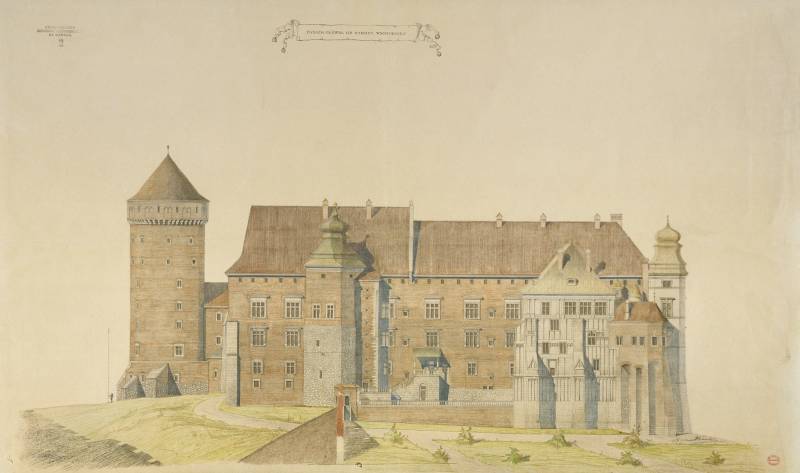
The Wawel had an important place in Wyspiański's heart and imagination. He set many of his dramas on the Wawel Hill, and he created an urban vision of the hill building development, turning it into the Polish Acropolis. With reference to the formal liberation of the Wawel Hill in 1903 (the Austrian army left the historic buildings in August 1905 and the other facilities as late as in 1911), the idea of transforming the hill into the administrative and cultural heart of Poland arose. Wyspiański, together with the architect Władysław Ekielski, was preparing the concept of the Wawel development for almost a year. On the slope, they planned to create an amphitheatre with 700 seats, following the example of the Greek theatre, and below a sports arena. The fortress walls were to acquire terraces and the barbican was to house lapidaries.

During the last 15 months of his life, Wyspiański was seriously ill and spent this time in Węgrzce near Krakow. He finished his commenced works, very often only by means of dictating them. "Stanisław Wyspiański departed this life on 28 November 1907 at 5 p.m. An autumn thunderstorm outside, the rain was beating against the windows, the gale was breaking tree branches. The night fell early …." Wyspiański's funeral took place in Krakow on 2 December 1907 and became a national manifestation. After the Mass in St. Mary's Church, the artist was buried in the Crypt of the Distinguished in the Skałka Church. The Wyspiański Museum, a department of the National Museum in Krakow, is situated at 11 Szczepańska Street, in the Szołayski tenement house.

Feliks "Manggha" Jasieński called Wyspiański "the eagle closed in a chicken pen".

    Guest book Page Map Start with MK Editor search Back up    
Copyrights by (1996 - 2010) ACK CYFRONET AGH.
Projekt graficznyFORMS Group