

Technikum hutniczo-mechaniczne
| Kategoria: | Nowa Huta na Europejskim Szlaku Kulturowym ATRIUM |
| Adres: | Osiedle Stalowe 16, Kraków |
Technikum hutniczo-mechaniczne (1951−1952, proj. Jan Suliga), os. Szkolne 37
Dom Młodego Robotnika (1953−1955, proj. Jan Suliga), os. Stalowe 16
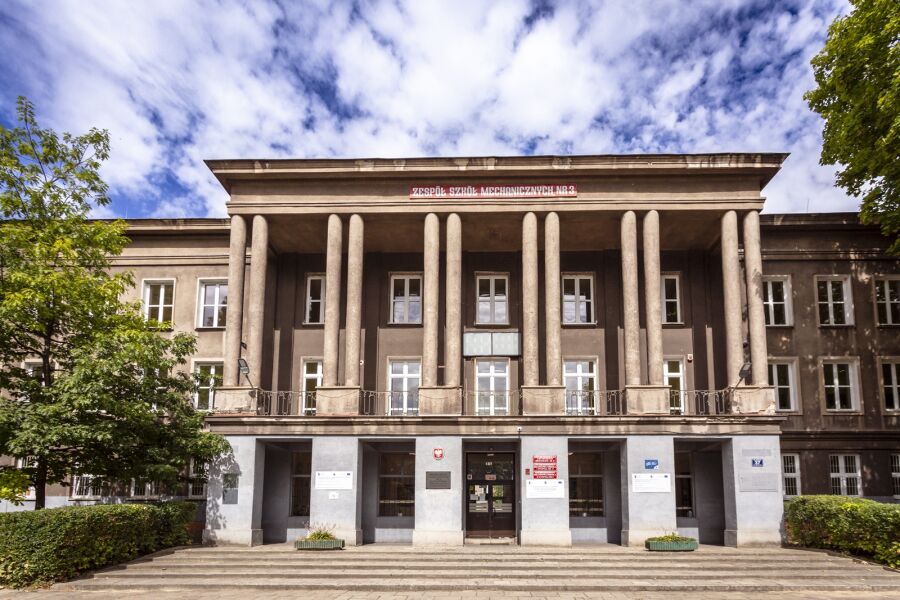
Monumentalne bryły Technikum Hutniczo-Mechanicznego i Domu Młodego Robotnika, zaprojektowane przez Jana Suligę, tworzą od wschodu symboliczną „bramę do Nowej Huty”, prowadzącą od huty ku centrum dzielnicy. Gmach technikum (obecnie Zespół Szkół Mechanicznych nr 3) powstał w latach 1951–1952 i nawiązuje do klasycystycznej architektury Politechniki Lwowskiej. Czteroskrzydłowa bryła z wewnętrznym dziedzińcem wyróżnia się monumentalnym portykiem wejściowym z parami zdwojonych kolumn, wysokimi oknami typu porte-fenêtre oraz dekoracyjnymi balustradami. Szkoła stanowiła kluczowy ośrodek edukacyjny dla kadry przemysłowej kombinatu. W schronie przeciwlotniczym pod budynkiem znajduje się wystawa „Stan zagrożenia” w ramach trasy turystycznej Podziemna Nowa Huta, udostępniana do zwiedzania w godzinach otwarcia. Uzupełnieniem założenia jest Dom Młodego Robotnika – dawny hotel robotniczy, utrzymany w reprezentacyjnej, pałacowej stylistyce socrealizmu z osiową kompozycją, ryzalitem i attyką. Oba budynki, choć pełniły funkcje użytkowe, otrzymały formę odpowiadającą ideologicznym założeniom epoki, łącząc monumentalizm z funkcjonalnością i urbanistycznym rozmachem.
[ENGLISH]
Steel and Mechanical Engineering School (1951−1952, designed by Jan Suliga), Os. Szkolne 37
Young Worker's House (1953-1955, designed by Jan Suliga), os. Stalowe 16
The monumental blocks of the Steel and Mechanical Engineering School and the Young Worker's House, designed by Jan Suliga, form a symbolic 'gateway to Nowa Huta' from the east, leading from the steelworks towards the centre of the district. The building of the engineering school (now known as the Mechanical School Complex No. 3) was constructed between 1951 and 1952 and refers to the classicist architecture of the Lviv Polytechnic. The four-winged block with an inner courtyard is distinguished by a monumental entrance portico with pairs of doubled columns, tall porte-fenêtre windows and decorative balustrades. The school was a key educational centre for the industrial staff of the steelworks combine. The air raid shelter underneath the building houses the 'State of Emergency' exhibition as part of the Nowa Huta Underground tour, open to the public during opening hours. The establishment is complemented by the Young Worker's House, a former workers' hotel, maintained in the representative, palace style of socialist realism with an axial composition, avant-corps and attic. Both buildings, although serving a utilitarian function, were given a form that corresponded to the ideological assumptions of the era, combining monumentalism with functionality and urban grandeur.
[ITALIANO]
Istituto tecnico metallurgico-meccanico (1951–1952, progetto di Jan Suliga), complesso residenziale Szkolne 37
Casa del Giovane Operaio (1953–1955, progetto di Jan Suliga), complesso residenziale Stalowe 16
I volumi monumentali dell’Istituto tecnico metallurgico-meccanico e della Casa del Giovane Operaio, progettati da Jan Suliga, costituiscono la simbolica “porta di Nowa Huta” da est, che conduce dall’acciaieria al centro del quartiere. L’edificio dell’Istituto tecnico (oggi Plesso scolastico meccanico n. 3) fu costruito tra il 1951 e il 1952 e si riconduce all’architettura classicista del Politecnico di Leopoli. Il volume a quattro ali con cortile interno si distingue per il monumentale portico d’ingresso con coppie di colonne binate, alte porte-finestre e balaustre decorative. La scuola costituiva un centro formativo fondamentale per il personale industriale del complesso siderurgico. Nel rifugio antiaereo sotto l’edificio si trova la mostra “Stato di minaccia”, parte del percorso turistico Nowa Huta sotterranea, visitabile negli orari di apertura. Il complesso è completato dalla Casa del Giovane Operaio – un ex albergo per operai, realizzato nello stile rappresentativo e palaziale del realismo socialista, con una composizione assiale, un avancorpo e un attico. Entrambi gli edifici, pur avendo una funzione utilitaristica, assunsero una forma conforme ai presupposti ideologici dell’epoca, combinando il monumentalismo con la funzionalità e lo slancio urbanistico.