

Smok Żołnierz CK – The Austro-Hungarian Imperial Soldier Dragon
| Kategoria: | Smoczy szlak |
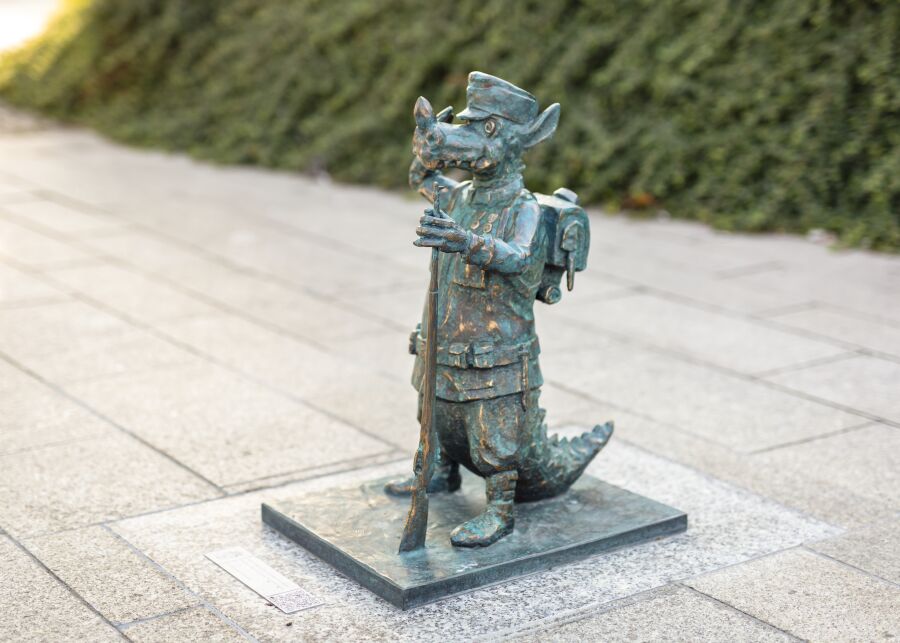
| Smok stoi w mundurze c. i k. żołnierza z karabinem obok ruin bastionu V „Lubicz” (the dragon stands in the uniform of a soldier of the Austro-Hungarian Empire with a rifle next to the ruins of Bastion V "Lubicz") | |
| Adres: | Rondo Mogilskie, Kraków |
Tego smoka nie należy zagadywać – pełni wartę. Jest wyekwipowany w karabin Mannlicher, magazynki do niego w ładownicach przy pasie, plecak oraz wojskową czapkę z okresu Twierdzy Kraków.
Smok pilnuje reliktów bastionu V „Lubicz” wyeksponowanych częściowo na terenie ronda. Cześć jest w formie murów, a część jedynie zaznaczona na płycie ronda. Wielkość dawnego bastionu można zobaczyć z 25. piętra pobliskiego biurowca Unity Centre. Jeśli jednak odwiedzający smoka chcieliby zobaczyć, jak taki bastion wyglądał, to może udać się do bastionu III „Kleparz”, bo były niemalże identyczne.
Oba bastiony, w których stacjonowali żołnierze i trzymano armaty powstały w latach 60. XIX w. Łączyły je wały, które biegły dzisiejszymi al. Władysława Beliny-Prażmowskiego, stamtąd do bastionu „Luneta Warszawska” przy ul. Kamiennej i al. 29 Listopada do bastionu „Kleparz”.
Jeszcze kilkanaście lat temu ten teren był zasypany, gdyż fortyfikacje, które strzegły Krakowa od strony traktu mogilskiego, uległ potrzebom komunikacji zbiorowej. Sam bastion choć przetrwał prawie 90 lat, szybko po wybudowaniu stał się przestarzały. Służył jako koszary i magazyny, a potem już tylko jako magazyny. W 1950 r. fort wyburzono i jago resztki zasypano. W latach 2004-2008 przy przebudowie ronda na dwupoziomowe z tramwajami na poziomie -1 odsłonięto zachowane fragmenty fortu.
Forty i żołnierze Twierdzy Kraków przydali się w czasie I wojny światowej. Umocnienia Twierdzy pomogły wojskom austro-węgierskim, wspieranym przez wojska niemieckie i oddziały legionowe zwycięsko odeprzeć rosyjskie ataki w listopadzie i grudniu 1914 r.
[ENGLISH]
This dragon should not be questioned – it is on guard duty. It is equipped with a Mannlicher rifle, magazines for it in the pouches at its belt, a rucksack and a military cap from the Krakow Fortress period.
The dragon guards the relics of Bastion V "Lubicz" exposed partly on the roundabout. Part is in the form of masonry and part is only marked on the roundabout slab. The size of the former bastion can be seen from the 25th floor of the nearby Unity Centre office building. However, if visitors to the dragon want to see what such a bastion looked like, they can go to Bastion III 'Kleparz', as these two were almost identical.
The two bastions where soldiers were stationed and cannons were kept were built in the 1860s. They were linked by a series of ramparts that ran along today's Władysław Belina-Prażmowski Avenue, from there to the "Luneta Warszawska" bastion on Kamienna Street and along 29 Listopada Avenue to the "Kleparz" bastion.
Until a dozen or so years ago, this area was covered up because the fortifications that guarded Krakow from the Mogiła route had yielded to the needs of public transport. The bastion itself, although it survived for almost 90 years, quickly became obsolete after its construction. It served as barracks and warehouses, and then only as warehouses. In 1950, the fort was demolished and its remains filled in. Between 2004 and 2008, the reconstruction of the roundabout into a double-deck roundabout with trams at level -1 uncovered preserved parts of the fort.
The forts and soldiers of the Krakow Fortress came in handy during the First World War. The fortifications of the Fortress helped the Austro-Hungarian army, supported by German troops and Legion troops, to victoriously repel Russian attacks in November and December 1914.