

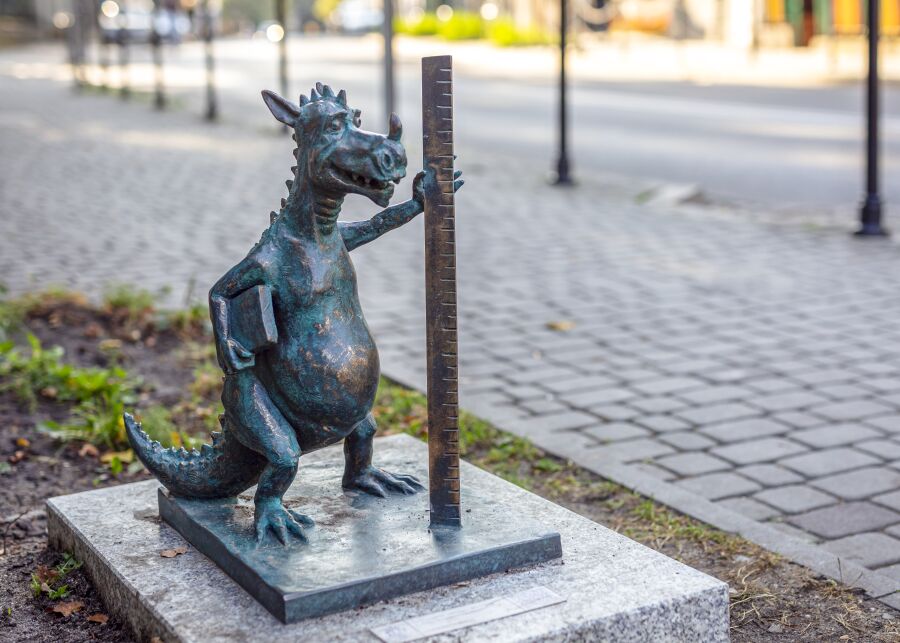
Smok z metrem – The Dragon with a Measuring Stick
| Kategoria: | Smoczy szlak |
| smok stoi przed ogrodzeniem kościoła św. Mikołaja (the dragon stands in front of the fence of St Nicholas Church) | |
| Adres: | ul. Kopernika 9, Kraków |
Smok z metrem stoi przed ogrodzeniem kościoła św. Mikołaja przy ul. Mikołaja Kopernika na wysokości latarni umarłych i prezentuje linijkę z podziałką.
Smok nie ma łatwego zadania, gdyż pragnie odwiedzającym przypomnieć o postaci niemal zupełnie zapomnianej. Mowa o Stanisławie Pudłowskim – fizyku i astronomie, rektorze Akademii Krakowskiej, który działał naukowo w XVII w. Do dyspozycji miał obserwatorium i pracownię fizyczno-astronomiczną w zabudowaniach probostwa kościoła św. Mikołaja. Sformułował koncepcję uniwersalnej długości, badając przebiegający przez Kraków południk. Wynaleziony przez krakowskiego uczonego metr wynosił 0,994 metra obecnie używanego, którego wzorzec znajduje się w Sevres pod Paryżem, czyli różnił się zatem od metra obecnego o jedynie 6 mm.
To nie wszystko. Stoimy bowiem przy jednej z najstarszych budowli sakralnych w Krakowie. Choć jest ona w stylu barokowym, to pochodzi z XII-XIII w. Kościół wiele przetrwał, bo i kilka pożarów, i zniszczenia, jakie doznał od najeźdźców atakujących miasto – od Szwedów w czasie potopu i Rosjan w czasie konfederacji barskiej.
Jako ciekawostkę, warto wspomnieć, że w 1910 r. w kościele wziął ślub Feliks Dzierżyński i Zofia Muszkat – oboje byli rewolucjonistami walczącymi z caratem, a Feliks Dzierżyński w przyszłości po rewolucji październikowej stał się jedną z najważniejszych osób w Związku Sowieckim, jako organizator takich służb jak: CzeKa, z której w przyszłości powstanie NKWD, KGB i współczesne tajne, wywiadowcze i kontrwywiadowcze służby rosyjskie.
Obok kościoła stoi latarnia zmarłych, która w średniowieczu stała przed cmentarzami i szpitalami dla chorych zakaźnie, aby płonący wewnątrz niej kaganek ostrzegał przechodniów przed morowym powietrzem. Ta konkretna stała niegdyś przy kościele na Kleparzu, ale po zburzeniu tamtej świątyni ostatecznie ją przeniesiono z pl. Słowiańskiego właśnie tutaj. W 2004 r. ustawiono też chaczkar – ormiański kamień krzyżowy – upamiętniający polskich Ormian oraz Ormian wymordowanych w Turcji w 1915 r.
[ENGLISH]
A dragon with a measuring stick stands in front of the fence of St Nicholas Church on Nicolaus Copernicus Street nearby the memorial ‘lantern of the dead’ and holds a graduated measuring stick.
The dragon does not have an easy task, as it wants to remind visitors of a figure almost completely forgotten. We are referring to Stanisław Pudłowski, physicist and astronomer, rector of the Krakow Academy, who was scientifically active in the 17th century. He had an observatory and physics and astronomy laboratory at his disposal in the rectory buildings of St Nicholas Church. He formulated the concept of universal length by studying the meridian that runs through Krakow. The measuring stick invented by the Krakow scientist was 0.994 of the metre currently in use, the standard of which is found in Sevres near Paris, so it therefore differed from the current metre by only 6 mm.
That's not all. For we are standing next to one of the oldest sacred buildings in Krakow. Although it is in the Baroque style, it dates from the 12th-13th centuries. The church has survived much, including several fires and the destruction it suffered from invaders attacking the city – from the Swedes during the Deluge and the Russians during the Bar Confederation uprising.
As a curiosity, it is worth mentioning that in 1910 Feliks Dzerzhinsky and Zofia Muszkat were married in the church – both were revolutionaries who fought against the Tsar, and Feliks Dzerzhinsky became one of the most important people in the Soviet Union in the future after the October Revolution, as the organiser of such services as the Cheka, from which the NKVD, the KGB and the contemporary secret, intelligence and counter-intelligence Russian services would be formed in the future.
Next to the church is the ‘lantern of the dead’, which in the Middle Ages stood in front of cemeteries and hospitals for infectious patients, so that the burning torch inside it would warn passers-by of the plague air. This particular one used to stand by the church in Kleparz, but after that temple was demolished, it was eventually moved from Słowiańskiego Square here. In 2004, a khachkar – an Armenian cross stone – was also set up in memory of Polish Armenians and Armenians murdered in Turkey in 1915.