

Smok Wodny – The Water Dragon
| Kategoria: | Smoczy szlak |
| Adres: | Plac Na Groblach, Kraków |
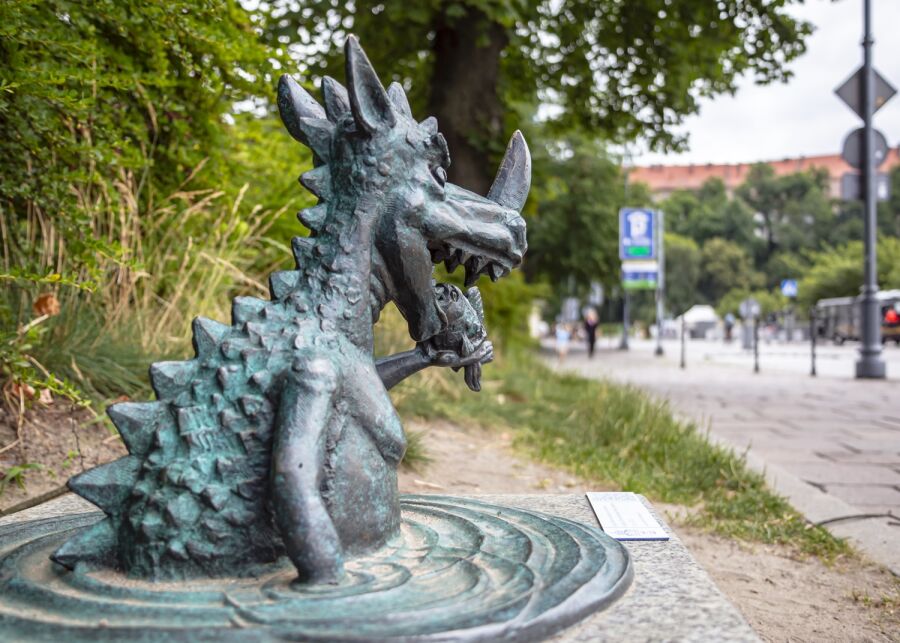
Smok Wodny z rybą w łapie stoi przy pl. Na Groblach. Jak sama nazwa wskazuje, niegdyś na środku obecnego placu był staw, który jednocześnie był dawnym portem wiślanym. Wspomnianymi groblami odcięto w średniowieczu rozległe zakole Wisły – biegnące od Salwatora, przez Błonia, w kierunku Starego Miasta i Wawelu – zakładając w nim liczne stawy rybne, a po sąsiedzku, port wiślany. Źródłem wody była Rudawa, dla której stawy i tereny podmokłe były jednym z ujść, spływały tam również nieczystości z fosy na przedpolu murów miejskich. Na tle wody w stawie i mokradeł wyraźnie odcinała się grobla. Na leżących nieopodal mokradłach, zwanych „Żabikrukiem”, wedle jednej z wersji legendy, miał utopić się smok wawelski. Gdy stopniowo osuszono stawy i mokradła, zastąpił je plac, na którym w każdy wtorek handlowano końmi. Wokół niego stawiano drewnianą, parterową i dość chaotyczną zabudowę. Dopiero pod koniec XIX w. plac zmienił swój wygląd. Wokół niego powstały kamienice oraz charakterystyczny gmach I Liceum Ogólnokształcącego im. Bartłomieja Nowodworskiego. Mimo, że stawy zniknęły, to woda jeszcze często wdzierała się na te tereny. Świadczy o tym fragment dawnego Browaru Królewskiego, w który wmurowano trzy tablice. Wskazują one poziom wody w czasie wielkich powodzi, których doświadczył Kraków w latach 1813, 1876 i 1903. Sam budynek browaru został wyburzony, a na jego miejscu wybudowano hotel. W kamienicach przy pl. Na Groblach mieszkali m.in. publicysta Ksawery Pruszyński oraz artysta Piotr Skrzynecki. Krakowscy artyści i goście imprez założyciela „Piwnicy pod Baranami” upamiętnili plac w swoich piosenkach. Obecnie, część placu służy młodzieży do uprawiania sportu (jest tu boisko z bieżnią), wydzielono również podziemną przestrzeń parkingową. Między nimi dostrzeżemy wynurzającego się oczka wodnego smoka z rybą, który przypomina o długich związkach wody z tym fragmentem miasta.
Idąc pod prąd Wisły, w kierunku Alei Trzech Wieszczów, spotkamy kolejnego smoka, wyposażonego w filmowy atrybut: kamerę.
[ENGLISH]
The Water Dragon with a fish in its claw stands at Na Groblach Square. As the name suggests, there used to be a pond in the middle of the current square, which was also the former Vistula marina. In the Middle Ages, these dikes cut off a wide bend in the Vistula – running from Salwator, through Błonia, towards the Old Town and Wawel – creating numerous fishponds and, in the vicinity, the Vistula marina. The source of the water was the Rudawa stream, for which the ponds and wetlands were one of the outlets; waste from the moat at the front of the city walls also flowed there. Against the backdrop of the pond water and wetlands, the dyke stood out clearly. According to one version of the legend, the Wawel Dragon is said to have drowned in the nearby marshland called "Żabikruk". When the ponds and wetlands were gradually drained, they were replaced by a square where horses were traded every Tuesday. Wooden, single-storey and rather chaotic buildings were erected around it. It was not until the late 19th century that the square changed its appearance. It was surrounded by townhouses and the distinctive building of the Bartholomew Nowodworski First Liceum. Even though the ponds have disappeared, water still frequently enters the area. This is evidenced by a section of the former Royal Brewery, into which three plaques have been embedded. They indicate the water level during the great floods experienced by Krakow in 1813, 1876 and 1903. The brewery building itself was demolished and a hotel was built in its place. Among those who lived in the tenements at Na Groblach Square were the publicist Ksawery Pruszyński and the artist Piotr Skrzynecki. Krakow artists and party guests of the founder of "Piwnica pod Baranami" commemorated the square in their songs. At present, part of the square is used by young people for sports (there is a pitch with a running track), and an underground parking area has also been allocated. Between the two of them, we notice a fish dragon emerging from the pond, a reminder of the long association of water with this part of the city.
Walking upstream on the Vistula towards Aleja Trzech Wieszczów, we will meet another dragon, equipped with a film attribute: the camera.