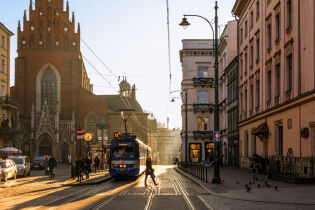






Kraków’s Kazimierz is a special place, because it has been shaped by the close neighbourhood of Christianity and Judaism lasting for several centuries. The Jews came to Kazimierz in the 2nd half of the 14th century, and till the first years of the 19th century they had lived there in the separate “Jewish town” whose limits largely followed today’s Miodowa, Św. Wawrzyńca, Wąska, Józefa and Bożego Ciała Streets. It was an autonomous enclave governed by rabbis and elected elders that recognised only the king’s supremacy held on his behalf by the Kraków voivode.
Only in the course of the 19th century and the first decades of the 20th century the Jews gradually dominated the entire Kazimierz, as well as the neighbouring district of Stradom. In the 2nd half of the 19th century the Jews took a large part in the expansion of the district as investors, construction entrepreneurs and architects. Their social and economic activity was fully triggered by granting them equal civic rights in 1867. The culturally assimilated Jewish intelligentsia more and more often decided to live outside of Kazimierz.
Before the outbreak of the Second World War Kraków was inhabited by over 64,000 Jews, that is, about 25% of its entire population. Till 1939 the Jews had created a well-developed social infrastructure aiming at the fulfilment of interests and aspirations of the minority. It was largely formed in Kazimierz which was a notably Jewish district of Kraków and the natural social base for the majority of Jewish organisations and institutions till the end of the inter-war period. It was the place of operation of political parties of all shades representing the Jewish population in the Polish Parliament, educational, charity, cultural, artistic and sports organisations. Kazimierz concentrated the religious life of the Kraków Jews. They prayed in six big Orthodox synagogues (Old, Remuh, High, Issac’s, Popper’s and Kupa) and the progressive synagogue of Tempel at Podbrzezie that were supported by the Commune, and in many prayer houses belonging to various religious associations and private persons.
Let us enumerate places related to the past of the Jewish community of our City.
House of Mordechai Gebirtig
5 Berka Joselewicza Street
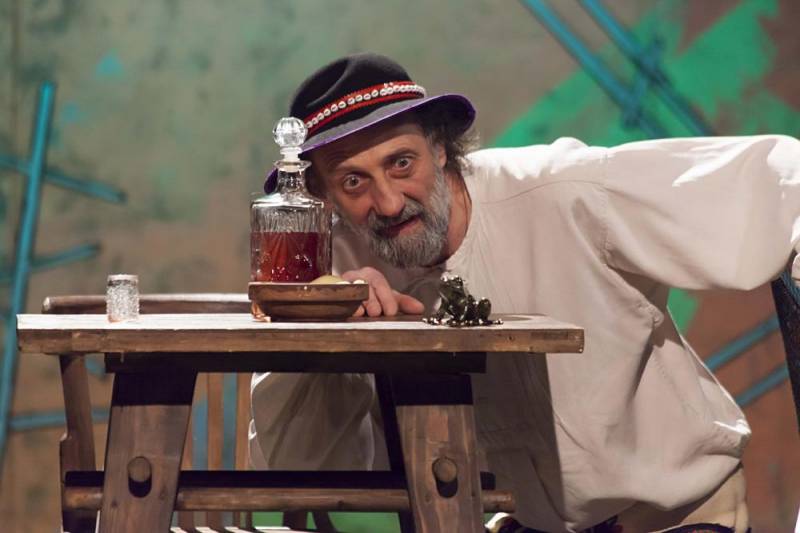
Mordechai Gebirtig, famous folk poet and bard of the Jewish street, lived in the outhouse of the building at 5 Berka Joselewicza Street. Gebirtig (Bertig) was born in Kraków on the 4th of May 1877. He died on the 4th of June 1942 murdered in the streets of the Kraków ghetto. He came from a poor family, and throughout his entire life he belonged to the circle of poor people. He finished his education in a cheder, a Jewish religious school. Initially, he earned his living as a Carpenter, and then furniture restorer at the furniture storehouse run by his brother Leon at 28 Starowiślna Street. About 1909 he married Bluma née Lindenbaum with whom he had three daughters. But Gebirtig was primarily an artist. Gifted with strong sensitivity and artistic talent, he played in an amateur Jewish theatre and wrote poems and songs that were later sung at the Jewish street, although not many people associated them with their author. Since Gebirtig himself probably was not familiar with music notation, the melodies to his own poems hummed by him were taken down by friendly musicians, mostly Juliusz Hoffman, composer and musicologist, and Baruch Sperber, composer and conductor of synagogue choirs. The best known pieces by Gebirtig are: Kinderjorn (Childhood Years), Unzere sztetł brent (Our Little Town is Burning), Rejzele (Rejzele), and Blajb gezunt mir, Kroke (Good-bye Kraków). Today his songs are sung mainly in Israel where the texts of many of them were translated to Hebrew. In Germany the Gebirtig’s output is admired and popularised by Manfred Lemm who performs the songs of the Kraków bard and authored a broad study about him. Many of Gebirtig’s poems have been translated into Polish by Natan Gross, Jerzy Ficowski and Agnieszka Osiecka. In Poland his songs are performed, for example, by Gołda Tencer, Sława Przybylska, Irena Urbańska and the Kraków Kroke group.
(Text based on the book by Natan Gross, Żydowski bard (The Jewish Bard), Kraków, 2000).
Szejrit Bne Emun prayer house
4 Bocheńska Street
Former Szejrit Bne Emun prayer house, built before the First World War according to the design of Henryk Lamensdorf. For many years after 1945 the building was derelict. After its adaptation in the 1990s it has been housing healthcare institutions and didactic point of the Jagiellonian University Medical College.
Szejrit Bne Emun prayer house
4 Bocheńska Street
Former Szejrit Bne Emun prayer house, built before the First World War according to the design of Henryk Lamensdorf. For many years after 1945 the building was derelict. After its adaptation in the 1990s it has been housing healthcare institutions and didactic point of the Jagiellonian University Medical College.
Jewish Theatre
7 Bocheńska Street
At No. 7 Bocheńska Street in the building erected in 1908 by Liebling and Oberleder there was the permanent stage of the Jewish Theatre in Kraków. Its establishment was largely due to the agents of the Kraków Bund and the enthusiasts of the Jewish theatre: Moses Kanfer, Abraham Seidenfeld, Frederick Freund, Maurice Fiszer, and two Jewish poets: Mordechai Gebirtig and Ber Horowitz. The stage’s inauguration took place on the 13th of October 1926. The theatre at Bocheńska offered guest appearances by distinguished actors and the best theatrical troops of those times. The Vilnius Troop performed The Dybbuk and Day and Night by Ansky, and Jealousy by Artsybashev. The actors included the famous Ida Kamińska, Turkovovs, Shimon Dzigan and Israel Schumacher. The theatre also had its own actors and could, therefore, entertain and move the audience drawing upon the abundant resources of the Jewish literature. From 1945 to 1986 the Railwayman Theatre was the host of the stage at Bocheńska.
Salomon Deiches’ house of prayer
6 Brzozowa Street
Former house of prayer of Salomon Deiches, situated at the back of the front townhouse. Built in 1910 according to the design by Henryk Lamensdorf, it was multi-storeyed building with terrace upstairs and the stone Decalogue plaques at the façade’s top.
Talmud Torah
6 Estery Street
Large corner building at the crossing of Warschauera and Estery Streets which housed the commune-supported Talmud Torah religious school in the inter-war period. Before the outbreak of the Second World War it was attended by about 1,500 students. It was run by the heads of synagogues and Chassidic houses of prayer. It also accommodated the Beit Meir rabbinic school set up by Rabbi Mendel Wechsler. Today the building houses the community health centre.
High Synagogue
38 Józefa Street
The High Synagogue was built as the third one in the Jewish town in Kazimierz, after the Old and New (Remuh) synagogues. It was built after 1556 but not later than in 1563. The synagogue’s name is derived from the fact that the room of prayer was situated at the upper storey of the building. This unusual location of the prayer room was adopted for security reasons as the synagogue was standing at the gate to the Jewish town, which is a particularly busy place full of street clamour and in very close proximity of the Christian properties. At the broader eastern side there probably were shops from the very beginning of its existence. At the end of the 1880s the men’s and women’s prayer rooms were added to the synagogue at the upper storey of the house neighbouring with it from the west. The synagogue’s fate during the Second World War 1939-45 and during the next six years after its termination has not been documented. Undoubtedly, it was a period of degradation of the building’s architecture and the total scattering of the synagogue’s furnishings, including in particular the valuable items of ceremonious art. Since 1966 the building has been used by the Heritage Conservation Laboratories.
The interior preserved only fragments of the old decor, including stone frame of the altar panel at the eastern wall and remains of wall paintings with texts of prayers discovered and preserved in the 1960s.
Koba Itim l'Torah prayer house
42 Józefa Street
From the beginning of the 19th century this storeyed house accommodated the prayer house called Koba Itim l'Torah which means those who devote their time to regular studies of the Torah. The building’s facade features the Hebrew name of the prayer house, and Hebrew dates of its establishment (1810) and restoration (1912) in two Stars of David. Today it is a residential building.
Building of the Jewish Religious Commune Board in Kraków
41 Krakowska Street – 2 Skawińska Street
Till the end of the 19th century the Jewish commune authorities, that is, the qahal, had been based at the Old Synagogue. In 1911 the new representative building of the commune board was constructed at the corner of Krakowska and Skawińska Streets according to the design by Herman Lamensdorf. On the first floor of the building there was the board’s office, and the second floor accommodated the representative session room and the archives. The rarity contained in these archives was the illuminated Hebrew Bible of the 14th century. Carried away to Germany, it finally reached Israel. On the ground floor there was the Ezra Judaic library set up in 1899 by a group of Zionist activists headed by Dr. Ozjasz Thon. During the Second World War the library’s collection was scattered.
The Jewish commune board in Kraków is based here also today. It also houses a kitchen which offers kosher meals to the members of the community.
Izaak Jakubowicz Synagogue
16 Kupa Street
The synagogue was founded by Izaak Jakubowicz (Ayzik Jekeles), the elder of the Kazimierz qahal, who obtained the permission to build it from King Władysław IV on the 30th of April 1638. Its construction was completed in 1644 and resulted in the largest and, in the past, the most exquisitely furnished of the Kazimierz synagogues. The spacious interior was covered with an arched vault with telescopes richly adorned with geometric stucco work. It encompassed the common space of the high room for men (with the dimensions of 12 x 16.9 m) and, above the vestibule on the western side, the empora for women that is considered to be the most impressive among those existing in the Kraków interiors. The external stairs leading to the empora gained their present shape in 1924.
In front of the synagogue there spanned a vast square which served till 1939 as a fish market, a characteristic and often photographed element of the Jewish district scenery in Kazimierz.
In 1997 it was made available to Kraków inhabitants and tourists who can view archive films about the life of Jews in the pre-war Kraków and their extermination during the Second World War in the synagogue’s remarkable interior.
Bne Emuna prayer house – Jewish Culture Centre
17 Meiselsa Street
The one-storey building at the corner of Meiselsa Street (No. 17) and the Nowy Square (No. 5) is the former Bne Emuna prayer house erected in 1886 according to the design by Jacek Matusiński. After the Second World War it was used for various economic purposes, e.g. it housed a carpenter’s shop. In the years 1988 -1993 the building was renovated and adapted for the Jewish Culture Centre of the Judaica Foundation according to the design by Dariusz Gruszka. The funds for this purpose were transferred by the US Congress and, to a much lesser extent, the Municipality of Kraków. The ceremonious opening of the Centre took place on the 24th of November 1993.
Psalm Fraternity’s prayer house
18 Meiselsa Street – 13 Bożego Ciała Street
Former prayer house of the Psalm Fraternity. The storeyed building with neo-Romanesque and neo-Gothic decorative elements on the elevations was erected in 1896 according to the design by M. Kopold. The prayer house’s premises are currently occupied by the “Krakowiacy” Song and Dance Group
Progress Synagogue
24 Miodowa Street
The Progress Synagogue, that is, the so-called Tempel (German for ‘temple’) was built in the years 1860-62 according to the design by Ignacy Hercok. Until the outbreak of the Second World War it was the synagogue of progress Jews; those who were in favour of cultural assimilation. The services at the Tempel followed the principles of liturgy reformed in the 19th century, and formally they were closer to services in Christian churches than those taking place in traditional synagogues. Apart from the cantor and the choir (in the inter-war period women also sang in the choir), the Tempel introduced weekly sermons delivered by preachers with academic education. The most distinguished of the preachers in this synagogue was Dr. Ozjasz Thon (1870-1936).
In the 1st half of the 1890s the synagogue was subject to large-scale reconstruction according to designs by Beniamin Torbe thanks to which it assumed its today’s eclectic character with the domination of neo-Romanesque elements. The characteristic three-axe facade of the synagogue employs solutions analogous to those of the facades of German synagogues erected about 1860.
In the interior decoration one should note the ark of Carrara marble placed in the apse, painting and stuccowork decoration, as well as stained glass windows introduced successively from 1894.
Today’s body of the synagogue was finally shaped in 1924 when the ground floor side aisles shorter than the older part of the synagogue were constructed.
During the German occupation of Kraków in the years 1939-45 the Tempel was used as a storehouse and its northern aisle was adapted for horse stables. Immediately after the end of the Second World War the synagogue started again to hold services. They were attended by both progressive and traditional Jews, and for this reason today’s bimah was placed in the prayer house.
In the years 1995-2000 the synagogue was thoroughly renovated.
New cemetery
55 Miodowa Street
The cemetery referred to as new was established in 1800 and then expanded in 1836 with another plot of adjacent land. Later it was expanded several times more, but in the inter-war period it ceased to be sufficient, and in 1926 the Jewish commune purchased land in the Wola Duchacka village near Kraków for another cemetery that was consecrated on the 6th of April 1932.
During the German occupation of Kraków in the years 1939-1945 the cemetery was severely damaged. The order was restored after 1957. In view of the total destruction of cemetery in Wola Duchacka it is an open Jewish cemetery in Kraków till the present day.
Cheder Iwri folk school and Tachkemoni gymnasium
26 Miodowa Street
Cheder Iwri folk school and Tachkemoni secondary school. Four-storey building was erected in 1929 upon the initiative of agents of the Kraków section of the Mizrachi Orthodox Zionist party. In 1945 it was a shelter for Jews returning from the camps.
Okrąglak
Nowy Square
The Nowy Square, commonly known till the present day as the “Jewish square,” was before the war and still is today a market square. In the middle there is a round commercial hall colloquially referred to as ‘Okrąglak’ built in 1900 and in 1927 leased by the City to the Jewish commune for a ritual poultry slaughterhouse. The slaughterhouse was shut down by the Germans at the beginning of the Kraków’s occupation during the Second World War, and ‘Okrąglak’ was restored to its commercial function.
Craftsmanship School
3 Podbrzezie Street
Two-storey building with two side wings was erected in the years 1937-38 by the Jewish Society of Folk and Secondary School in Kraków. The main building housed the secondary Craftsmanship School, while the wings were used as school workshops. Today it houses the Institute of Biology of the Pedagogical University of Kraków.
Hebrew Gymnasium
8/10 Podbrzezie Street – 5 Brzozowa Street
The complex of three- and four-storey buildings erected in the years 1918, 1924 and 1931. At the corner buttress of the building there are plaques with inscriptions in Hebrew and Polish commemorating that it used to house a primary school (5 Brzozowa Street), Chaim Hilfstein’s Hebrew Gymnasium (8/10 Podbrzezie Street) of the Jewish Society of Folk and Secondary School in Kraków. The Gymnasium taught general subjects in Polish, and Judaic subjects in Hebrew. High level of education was guaranteed by excellent teaching staff that included: Hirsz Szerer, mathematician and school director; Juliusz Feldhorn, teacher of Polish studies, poet and translator of French and German literature; Chaim Löw, also teacher of Polish studies and writer; Joachim Metallman, natural scientist and senior lecturer of the Jagiellonian University; and Bencjon Katz, Hebraist and lecturer of this language at the Jagiellonian University.
Today it houses the complex of occupational schools.
Jewish Academic House
3 Przemyska Street
This house was built in the years 1924-26 upon the initiative of the Kraków branch of the Bnei Brit – Solidarity Association and the ‘Bonfire’ Association of the Jagiellonian University Students. The funds for the construction of the house came from the University and contributions from the Kraków Jews. The building was designed by architect Adolf Siódmak, and the interior decoration is the work of architect Tobiasz Wexner who also directed the construction works.
The Jewish Academic House became an important centre of social and cultural life of the Jewish community in Kraków. In the 1930s its representative room frequently held the presentations of works of the members of the Association of Jewish Painters and Sculptors: Artur Markowicz, Abraham Neuman, Szymon Müller, Wilhelm Grünberg, Leon Lewkowicz, Antoni Soldinger, Jakub Glasner, Henryk Hochman and others.
In October 1939 in the academic house deserted by students the Germans set up a brothel for the troops.
Today, similarly to the past, the building performs the function of the academic dormitory.
Jewish hospital
8 Skawińska Street
By the end of the 18th century the hospital of the Jewish commune in Kazimierz was located at the Nowy Square. In 1822 it was moved to a one-storey building in 8 Skawińska Street. In the years 1833 and 1838 the hospital building was expanded which established beds for 40 sick people and a flat for the manager.
Till 1831 the head doctor of the hospital was Dr. Julian Sawiczewski, and then Henryk Saul Rosenzweig (1794-1853) who came from Krakow and completed his medical studies in Berlin. Later the function was taken over by Dr. Józef Oettinger (1818-95), graduate of the Faculty of Medicine at the Jagiellonian University. Dr. Oettinger also initiated the construction of the new hospital building which started according to the design by Antoni Stacherski in the garden of the previous hospital in 1861 and lasted till 1866.
Before the First World War the hospital had several wards and specialist outpatient departments furnished with modern medical equipment.
In October 1941 the hospital was located in the Podgórze ghetto. The desolate building in Skawińska Street was adapted by Germans for furniture storehouse.
Since the end of the Second World War the hospital building at 8 Skawińska Street has been used by healthcare units. It houses the clinic of the Institute of Internal Medicine of the Medical College in Kraków, outpatient clinic of the Gabriel Narutowicz Hospital, antituberculotic clinic of Dr. Anka’s Hospital and district
Kupa Synagogue
8 Warszauera Street
The Synagogue was established in the 1640s for the funds of the qahal (mi-kupat ha-kahal) and for this reason it bears the name of Kupa till the present day.
In the 2nd half of the 19th century, as a result of the construction of Miodowa Street, the garden between the street and the northern elevation of the synagogue was established. Soon it was the site of a storied outhouse with sanitary facilities, as well as connecting porch to the west empora for women. In the last years of the 19th century the synagogue was expanded by way of integral connection to the stone house neighbouring with it from the east. In the inter-war period many conservation and aesthetisation works were conducted in the synagogue and its vicinity. New paintings were completed inside, and the building was encircled with decorative fence.
During the German occupation in the years 1939-45 the synagogue was largely devastated. The bimah and the platform with stairs and cantor’s pulpit before the ark were totally destroyed. The entire movable artistic furnishing was lost.
For several years after the end of the Second World War the synagogue held prayer gatherings. It also performed other functions. In the years 1946-47 the matzah factory was based there. In one of its rooms a ritual poultry slaughterhouse was set up and functioned there till 1985, that is, till the death of shochet Abraham Lesman. In the north-west outhouse lived Jewish families who came after 1945 from the USSR. In the years 1956-1991 the synagogue building was used by a production cooperative. Today its conservation is in progress, and the building awaits the appointment of its new function.