







wersja dla przeglądarki głosowej


Practical information
Arrival
City Centre Map
Tourist Information Network
Hotels
Recommended Restaurants
Polish Language Courses
Money, shopping
Dear turist! You are not helpless!
Important telephone numbers
Post offices, Fax, Internet
City guides
Trips around Krakow and vicinity
Krakow Tourist Card
Transport
Krakow's Main Attractions
The Royal Castle on Wawel Hill
The Main Square
St Mary's Church
The City Centre
Kazimierz District
Vistula River Trips
Nowa Huta District
From a Slightly Different Angle
Aqua Park in Krakow
Krakow Valley Golf & Country Club
Royal Kraków Golf & Country Club
Outside the city
Gourmet Tourism
Tourist routes and guides
The Royal Route
The University Route
In the Footsteps of John Paul II
Jewish Heritage Route
Saint Stanislaus of Krakow Route
Podgórze Historical Route
Nowa Huta Route
The Krakow Iindustrial Heritage Route
Other
Publications to download
Krakow ABC

Tourism


Wawel


Kanonicza, the street usually taken to access the famous Wawel Hill, is short and fairly narrow. Yet it is one of the most important and ancient streets of the city; a street whose look has hardly changed over the centuries - authentic and very much alive. Moreover, Kanonicza provides an example of favourable changes that have continued in Krakow in recent years: the complex restoration of city's heritage and preservation projects which unveil the city's true beauty layer by layer.

A look at a plan of the city shows that the space contained by the walls of the castle is similar to that of the Main Market Square. In the castle's many chambers, exhibitions that simply cannot be missed await you: royal chambers and stately rooms, collections of Oriental art and military trophies, collections of Flemish tapestries of amazing beauty, as well as archaeological specimens. They are testimony to more than a millennium of Christianity in Polish Lands. It was here, in the Royal Castle, that the monumental exhibition entitled Wawel 1000-2000 was organised in the year 2000 to illustrate the development of Polish statehood. Worth visiting in the castle grounds are the Wawel Cathedral, the Royal Tombs - crypts containing royal sarcophagi, where we walk among Poland's entire history, and the massive "Sigismund" Bell, which peals only to commemorate events of the greatest importance to the country and the city. Half a day is hardly sufficient to see all these even if you hurry.

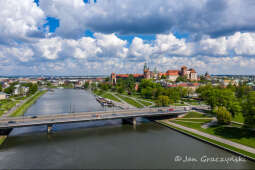
Yet there is more to Wawel than just exhibitions. Even if you were to postpone visiting the castle until your next, longer visit in Krakow, spend a while in the ring of castle walls late in the afternoon. The gates are open much longer than the exhibitions, and you will have a chance to see the arcaded courtyard of rare beauty, the cathedral, and to look across to the other side of the Vistula River. Here is where the famous Manggha Centre of Japanese Art and Technology stands, housing the Japonica gathered by one of the most famous European collectors, Feliks "Manggha" Jasieński. Having descended to the banks of the river, we can see the Dragon and the entrance to his den: a favourite destination on family strolls. During St John's Night (June), this place becomes the stage for the huge open-air event: Wianki - the Floating of the Garlands, continuing an ancient, pagan tradition.

More information: www.wawel.krakow.pl/emenu.htm

 Multimedia...
Map
Webcams
Panorama
Wallpapers
Photos to download
E-postcards
Photogallery
    Guest book Page Map Start with MK Editor search Back up    
Copyrights by (1996 - 2010) ACK CYFRONET AGH.
Projekt graficznyFORMS Group