





wersja dla przeglądarki głosowej


Krakow ABC
ABOUT BEER DRINKING TRADITION
ADAM MICKIEWICZ MONUMENT
BŁONIA
BELL-RINGERS
BELLS AND SMALL BELLS
CABS
FIRST CAFÉS IN CRACOW
THE FIRST CITY CLOCKS
FIRST F&B OUTLETS IN CRACOW
THE FIRST POLISH PERIODICAL
THE JAGIELLONIAN UNIVERSITY
LAJKONIK
THE SIEMIRADZKI CURTAIN
NAWOJKA
OSCAR
PALACE OF THE WIELOPOLSKI FAMILY IN KRAKOW
PATRON SAINTS
RHINOCEROS
ST. MARY'S BUGLE-CALL
THE STANISŁAW WYSPIAŃSKI MONUMENT
TAPESTRIES
TRAMWAY
WAWEL PLAQUES

Krakow ABC

KRAKOW ABC


There are a number of conceptions explaining the origins of the name "Krakow". One of them derives the city's name from the word krak, denoting a raven, another from the name of a legendary prince - Krak. The first known written mention of Krakow, as an important trade town, comes from a report by Ibrahim ibn Jakub of about 966 A.D.

In the past, as the capital of the country and the seat of Polish kings, Krakow attracted great scientists and artists from all around the world. It is to their talents and imagination that we owe the city's many unique historical monuments, representing the most important trends in the European culture. Each place here has its own history, and numerous interesting legends and tales related to them still survive in the inhabitants' memories.

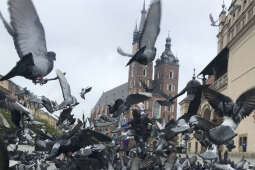
The Krakow Market Square, set out in 1257 during the granting of the Magdeburg rights to the city, is still one of the largest in Europe (about 200 x 200 metres). As early as in the 12th century, a network of mostly perpendicular streets was set out around the Market Square, with the earlier buildings incorporated into them in places (among others, Grodzka Street). In the centre of the Market Square, a medieval trading hall, Sukiennice, was erected, as well as the town hall, of which only the tower has survived until our times.

In order to ensure peace and security to the inhabitants, Krakow was surrounded by a double belt of ramparts, with numerous towers and several gates (their construction commenced in 1285). With time, in view of both the city's expansion and the dilapidation of the ramparts themselves, they were progressively pulled down.

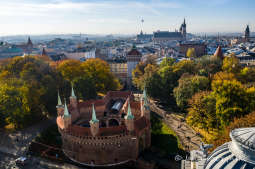
In 1810-14, most of the city ramparts together with the towers were pulled down and the moat was filled in. In 1820, the city decided to establish "city gardens" in their place. This gave rise to a city park surrounding the historical centre of the contemporary Krakow, known as Planty. For representation purposes, only a small section of the ramparts surrounding the Floriańska Gate and Barbican were preserved. In the Middle Ages, the powerful brick churches also played some role in the city's defence.

Another great tourist attraction of Krakow is the ring of 19th century fortifications surrounding the city at its outskirts. The fortifications were erected by the Austrians as the so-called Krakow Fortress. Several of the forts are functioning after adaptation as cultural centres, for instance Fort 49 - "Krzesławice".

Krakow, situated on a communication and trade route, was a dynamic urban and commercial centre of the region. Since 1364, it has also been a university town. The historical monuments of Collegium Maius, Collegium Minus, Collegium Novum, and Collegium Juridicum constitute the most prestigious part of the university up to this very day. Krakow has always been, and still is, an important cultural centre.

The splendour of the bygone times is evidenced by the Krakow tenement houses, preserved until this very day. The richly decorated elevations can be admired around the Market Square - as well as in Floriańska, Grodzka, Bracka, Kanoniczna and other historical streets. An interior of a 19th century bourgeois tenement house can be viewed in the Hipolitów Tenement House (Plac Mariacki 3, a division of the Historical Museum of the City of Krakow).

Art and cultural life developed in the city. The role of Krakow as a place of intensive cultural activity and national memory was especially invaluable during the partition of Poland. The oldest Krakow theatre, Heleny Modrzejewska Stary Theatre, has operated in Krakow since late 18th century (currently, it is housed in a tenement house on the corner of Jagiellońska Street and Szczepański Square). In 1839, construction of an eclectic building of J. Słowacki Theatre, modelled on the Paris Opera, was completed. The building, designed by Jan Zawieyski, was erected at the former location of the demolished Holy Spirit convent and hospital.

Presently, there are about 20 repertoire theatres in Krakow, as well as a number of smaller theatre stages in small, climatic cellars, intensively used by numerous theatre formations and groups. In the summer season, a lot of additional theatre projects take place in the open, among others, in the yards of Krakow tenement houses and in gardens.

There are over 30 museums in Krakow. The most important of them include the State Collections of Art - Wawel Royal Castle, the National Museum with a large collection of Polish and world paintings and the Czartoryskich Museum in Krakow with the famous picture "Lady with a weasel" by Leonardo da Vinci.

Numerous cultural centres and houses of culture pursue a broad range of activities in the area of culture. Annually, they are organising hundreds of exhibitions and concerts, as well as diverse forms of educational events for the inhabitants of Krakow.

In Krakow, there are many monuments and plaques commemorating numerous people and historical events. The best known of them include a monument to Adam Mickiewicz in the Market Square, the Grunwald monument erected on the 500th anniversary of the Grunwald battle, the monuments to Mikołaj Kopernik, Tadeusz Kościuszko, Józef Dietl, and those decorating Planty and the Jordana Park.

In 1978, the historical Old Town and Kazimierz areas were placed on the first UNESCO World Heritage list.

Krakow's attractiveness is created both by places and by the people, who in developing the city's cultural offer, try to take into consideration the needs of a wide range of audience: the inhabitants of Krakow and visitors. The city hosts numerous festivals. Many of them have rich traditions and a regular audience. Year after year, new projects are also developed, including those initiated over the recent years: Misteria Paschalia, Sacrum-Profanum, Museum Night, Polish Music Festival - presenting the works of Polish music performed by the world's greatest artists, and the Dramas of Nations Festival.

According the ranking carried out by Travel+Leisure, a high-circulation monthly, in August 2006, Krakow is among the five European cities perceived as the best, together with Florence, Rome, Venice and Istanbul. In late 2006, a great American travel agency Orbitz proclaimed Krakow the most fashionable city of the year 2007. Earlier, in 2005, the company Project for Public Spaces proclaimed the Krakow Market Square the best square in the world, ranking it even over the St. Mark's Square in Venice. (J.Sz-Ł.)

    Guest book Page Map Start with MK Editor search Back up    
Copyrights by (1996 - 2010) ACK CYFRONET AGH.
Projekt graficznyFORMS Group