






Józefa Street. The return from the prayer.
Photo Tadeusz Przypkowski, around 1930.
"On the festive days Kazimierz become quieter and calms down. The Jews dressed in long gaberdines, in hats hemmed with fox fur, walk in the streets. The synagogues get filled with praying people. The Jewish town creates a strange, not devoid of charm, picture..." wrote Karol Estreicher. On the photograph - the group of pious Jews in traditional attires, who return from the religious service.

The flea market in Szeroka Street.
Photo Photographical Agency "Światowid", around 1930.
Karol Estreicher in "The guidebook for those visiting the town and its surroundings" (published in 1938) wrote about Kazimierz from those days in that way: " At present Kazimierz is a typical example of a trade ghetto. The living here Jewish people are usually poor. The more rich ones are merchants, the poorer - agents or minor salesmen. The most poor busy themselves with artisanship or selling of junk. [...] On Tuesdays and Fridays the flea market take place in Szeroka Street".
On our photograph there are women with armfuls of clothes designed for selling. Further - the gate leading to the yard next to Remu Synagogue.

Dietla Street.
Photo Ignacy Krieger, around 1910.
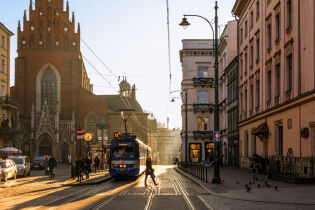
The today's street was marked out when the historical bed of the Vistula River was filled. The Old Vistula was slowly becoming the drying-out, malarial marshes. In 1878 the bed of the Old Vistula started to become filled and at the same time the street was being bricked. The monumental town planing guidelines included the wide lane of greenery with two parallel walking alleys, lines of trees and flower beds as well as two strips of the road. The event took place at the time of Józef Dietl presidency and as soon as in 1879 the street got it present name. The composition, very modern as for those days, remained unchanged until 1970. In that year the route of tramway communication was built there and because of that the lane of greenery was devastated. At present it is the lawn next to the tracks and a few remaining trees.

The view over Kazimierz from the east.
Photo Ignacy Krieger, around 1885
On the left the spire figure of Gothic Corpus Christi Church from 14th century. On the right compact building structure of this jewish town with low tenements. Close to former defence wall of Kazimierz, characteristic building of the Old Synagogue. On the first plan one sees wet meadows of Dajwór with a cart-track, where nowadays are buildings of a gas-plant, power station and tramway depot.

Skałeczna street.
Photo Photographic Agency "Światowid", 1935
The name of that picturesque street comes from a road leading to the Saint Michael's Church in Skałka (on the Rock). On this photograph, taken in 1935, we can see its part between Augustiańska and Krakowska streets with a view over spire tower of Corpus Christi Church. The tenements on the left side of the street were built as late as in 1912-1918, according to plans of the architect Jan Zawiejski. On the right one notices the side-wall of medieval tenement, called The Star or The Dark Star, that used to be the property of Regular Canons convent. In 18th century it was bought from impoverished Canons by a rich burgher Jan Bekierski. Deep inside exactly opposite the outlet of Skałeczna street one can see the fragment of Krakowska street, where earlier had been a ruined tenement number 28. It was pulled down in the 20' of 20th century to open the view over Corpus Christi Church.

The Town Hall of Kazimierz. View from the east.
Photo Walery Maliszewski, around 1865
We show the photograph with a view over Wolnica square, former market of Kazimierz, with a figure of the Town Hall dominating it. On the square, which name comes fom free trade (wolny means free), as late as in the 50' of 20th century meat, dairy, vegetables and building materials were sold. The Town Hall, that used to be an abode of the town authorities, was erected soon after the location of Kazimierz in 1335. We don't know if it was brick from the very begining or maybe earlier wooden. The present Town Hall was formed after the rebuilding in 16th century, when it gained the Renaissance attic. On this photograph it is a bit disfigured by some annexes. Also the devastaions of the building can be noticed, especially on the attic. As late as in 1876 the Town Hall was renovated and extended. On the right stand, non-existent nowadays, one-floor building with a picturesque roof, supported by buttresses and, remaining in non-changed style, Classicial, two-floor tenement from 1836-39 (Krakowska 29 street).

The fragment of Wolnica square in Kazimierz. Photo Ignacy Krieger, around 1909
This nowadays not too extensive square once used to equal in size the Main Market. It was also similarly planned: with a Town Hall in the middle and - visible on our photograph - the Corpus Christi Church, situated in the south-east corner (which reminds situation of Mariacki Church). The church was founded in 1380 by the king Ladislaus Jagiełło for Lateran Regular Canons brought to Krakow in 1405. It is Gothic, built from bricks decoratively arranged in rhomb pattern, supported by buttresses, with triangle top and high tower, it attracts the attention with its majestic figure. The houses visible on the photograph, "closing" the square next to the church, built mostly in the first half of 19th century in following years were reconstructed or pulled down and on their place the new ones were built. To the end of the interwar period the square was one of town markets. The people traded there with for instance pottery goods and building materials.