






The mound of Tadeusz Kościuszko and the panorama of Cracow.
Photo Photographic Agency "Światowid", 1934
In 1846 Cracow was incorporated in Austrian monarchy. The town close to border became for Austria the strategic point of fundamental millitary importance in a possible war with Russia. Emperor's decision to fortify Cracow was taken in 1850, but already in years 1848-49 intensive works were carried out at Wawel, that turned the royal hill into a citadel dominating the town. In years 1850-54 for instance the big forts round the mounds of Tadeusz Kościuszko and Krakus (the legendary founder of Cracow), Warszawska and Grzegórzecka demilunes and maximillian towers in Krzemionki were erected. The count August Caboga, a co-author of Austrian fortification system, prepared the plans and supervised the building.
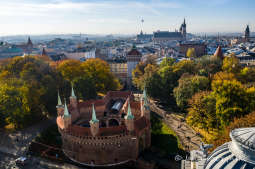
In the following years during "eastern crisis" (Crimean war) Cracow was transformed from an encampment into a fortress encircled with 5-kilometer-long earth bank, reinforced by trenches. On the photograph taken almost 80 years later we see the fort "Kościuszko" from the western side. On the foreground - the face of the fort with huge bastions. Inside of the strongholds - the mound with masonry basis, next to whch stands the Neogothic chapel of blessed Bronisława. On the right we see the road lined with trees, which leads to the mound; underneath the Vistula. On the left Błonia spread out. Deep inside the panorama of Cracow with characteristic figures of churches and Wawel Hill.

The mound of Tadeusz Kościuszko and the fort from the air.
Photo Photographical Agency "Światowid", 1935
The mound of Tadeusz Kościuszko was heaped up in years 1820-23 on the hill of blessed Bronisława. 30 years later Austrian authorities, turning the town into a fortress, erected a fort surrounding the mound. The committee that took care of the fort made an agreement with military authorities, according to which there was a free access to Kościuszko's tomb from the dawn till the sunset. The fort on the photograph, designed by August Caboga, is unique in European range. It had a form of a hexahedron surrounding the mound situated in the centre. The face (on the left) consisted of three huge bastions and two caponiers between them. On the side bastions the refuges were added. The most monumental part were great gorge-barracks, situated at the back of the fort (on the right). The fort "Kościuszko" was an ideal observation point and from its bastions one could bombard the Vistula's Valley. The building, consisting of several yards, a dozen or so gates and several hundred loopholes, being the defence labyrinth, could defence itself a whole or any part separately. After the Second World War the decision was taken to pull down the fort. The battle-face was demolished, only the right, devasteted bastion remained. Luckily the resolute action of Cracow's scholars saved the rest of the structure, that was appriopriated for a hotel.

The view over eastern side of Tadeusz Kościuszko's mound with its fortifications.
Photo Ignacy Krieger, around 1868
The view from the town over the back side of the fort - a huge block of barracks, reminding a medieval castle, topped with two watch-towers. In case an enemy would force his way to the backs of the fort, the edifice was secured by moved forward salients in a form of bastions - two at the edges and the central third. They had the shape of pentagonal towers, from Italian called "puntone". The access was also secured by thick walls, lines of loopholes and fixtured shutters with embrasures for small arms. Around 700-800 soldiers and officers were stationed in those barracks.

The way leading to the mound of Tadeusz Kościuszko.
Photo Photographical Agency "Światowid", 1931
In 1845 the reconstuction of the former way leading to the chapel of blessed Bronisława was started. The new beaten road, that facilitated the access to the nound, started to be formed. The funds for that purpose were given by a member of The Committee of the Building Tadeusz Kościuszko's Monument - Franciszek Ciesielski. The works lasted for two years and original, fairly expensive plan of Teofil Żebrawski was modified by Feliks Radwański and Karol Kremer. When the fort was built, the millitary authorities lined the road with trees on both sides, forming a lane. It played two roles: it camouflaged the movements of own troops and in case of necessity of defence the cut-down trees could efficiently bar and block the way. In 1912 the street was given the name of blessed Bronisława. Twenty years later a part of the street, closer to the mound, was changed into an avenue of George Washington, due to 200 anniversary of his birthday. On the photograph we see the Cracow citizens on their walk on Easter Monday. Deep inside the figure of Kościuszko's mound dominating the barracks.

The view over the mound of Tadeusz Kościuszko from the former military road (nowadays Piastowska street), around 1910
The tension in relations with Russia, caused by Crimean war, made Austrian military authorities to the extension of the encampment. Thick cordon of field-trenches with around 700-meter-long gaps between them were built around the town. That system of fortifications was linked by a special by-pass at the subsidiaries of the defence line. That road, earlier a route of shifts of 100 000 crew people and around 700 cannons of the fortress, up to nowadays is a beatiful line with a view. The road on the photograph was traced out in years 1855-70 as a part of that by-pass. The name - Piastowska - was given to it in 1912. We see a marching squad of soldiers probably making its way to the barracks below the mound of Kościuszko. At the sides of the street - characteristic low building strucure. For many years the fortifications restrained spatial development of the city and building-trade on the suburbs. Beyond the line of defence banks that surrounded Cracow one couldn't erect higher buildings and the owners of newly built houses were made to undersign so called demolition-vouchers. They commited themselves to pull their houses down on their own expence at any request of military headquaters.